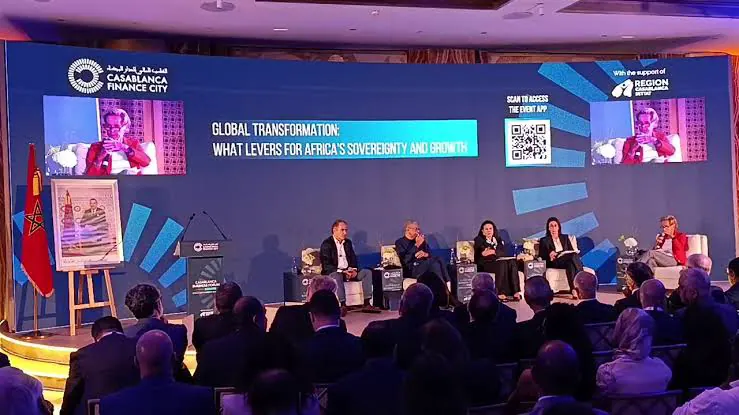
The second edition of the Casablanca Business Forum, held on October 2, 2026, brought together experts to discuss Africa's role in the evolving global landscape. The forum focused on leveraging new geopolitical configurations to foster growth and sovereignty. Participants stressed the importance of diversifying partnerships, reducing industrial and technological dependencies, and developing local capacities. This approach aims to empower Africa to navigate the complexities of global power dynamics effectively.
The panel discussion, titled "Global Recomposition: What Levers for Sovereignty and Growth for Africa?", highlighted the need for Africa to master its infrastructure, data, talent, and digital technologies. Minister of Digital Transition and Administrative Reform, Amal El Fallah Seghrouchni, emphasized the emergence of a new concept of sovereignty that encompasses digital sovereignty. This includes infrastructure, computing capacity, and regulation, which are crucial for Africa's participation in ongoing technological transformations.
Minister Seghrouchni noted that Africa has the potential to insert itself into the artificial intelligence (AI) race, despite significant investments by the US and China. She highlighted the continent's skilled workforce and the possibility of developing AI models and tools tailored to African needs. These innovations can support the continent's development and help bridge the technological gap.
Amina Benkhadra, Director-General of the National Office of Hydrocarbons and Mines (ONHYM), emphasized Africa's strategic importance in the global energy and digital revolution. She advocated for connecting productive zones, developing communication networks, and fostering regional markets to integrate into international value chains. Benkhadra stressed that greater sovereignty and investment attraction are essential for Africa's growth, particularly in energy infrastructure.
The African-Atlantic Gas Pipeline was cited as a cohesive development vision shared by 13 countries. This project aims to transport gas from exporting countries, such as Nigeria, Senegal, and Mauritania, to countries that need it for development. Benkhadra highlighted the need for sustainable energy access to develop mineral resources and increase added value.
Patrick Dupoux, Director-General and Senior Partner at Boston Consulting Group (BCG), noted that Africa and Europe face similar strategic challenges in the new global geopolitics. He described them as "objective allies" in a context dominated by China's industrial and US digital supremacy. Dupoux suggested that this situation opens the door to "co-protection" between Europe and Africa, particularly in manufacturing and digital sectors, to strengthen exchanges and reduce the continent's industrial dependence.
The Casablanca Business Forum 2026 included various sessions on topics such as Africa's competition for capital, transforming climate ambitions into actions, connecting Africa through infrastructure and integration, and mobilizing talent. The forum was initiated by Casablanca Finance City (CFC) under the theme "Africa's Next Economic Chapter". Professor Philippe Aghion, 2025 Nobel laureate in economics, also participated via videoconference, discussing conditions for leveraging economic and technological changes for sustainable growth and productivity.
Key points
- Africa must diversify partnerships and reduce dependencies to strengthen economic and digital sovereignty.
- Developing local capacities and mastering infrastructure, data, and digital technologies are crucial for Africa's growth.
- The Casablanca Business Forum 2026 highlighted opportunities for cooperation between Africa and Europe in the face of global power shifts.