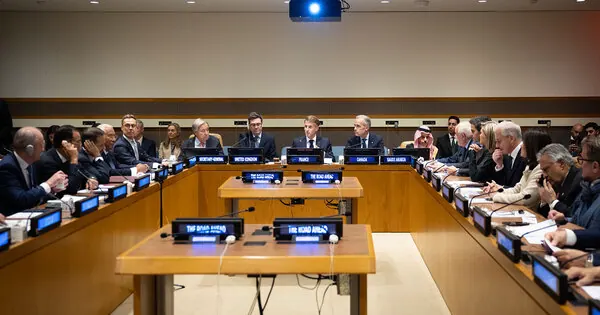
A high-level meeting at the United Nations, titled "The Road Ahead," was hosted by Canada, France, Saudi Arabia, and the United Kingdom, focusing on the two-state solution and a comprehensive peace plan for Gaza. Canadian Prime Minister Mark Carney emphasized Canada's longstanding and resolute support for a two-state solution. In a post on X, Carney stated that the meeting aimed to create conditions for lasting peace, where Israelis and Palestinians can live side by side in safety and dignity.
The United Kingdom, France, and Canada formally recognized the State of Palestine in September 2025 during a coordinated international push at the United Nations. UN Secretary-General Antonio Guterres reiterated that the two-state solution remains the only credible path to lasting peace and security for Palestinians, Israelis, and the wider region. Guterres emphasized that support for the two-state solution must translate into action, stating that there is simply no alternative to this approach.
Guterres outlined the objective of the two-state solution, which is to establish two independent, sovereign, and democratic states, Israel and Palestine, living side by side in peace and security. He stressed that this solution is based on pre-1967 lines, international law, relevant Security Council resolutions, and prior agreements. European Council President Antonio Costa expressed concerns that hopes generated by international efforts over the past year have not translated into sufficient improvement on the ground.
Costa called for the full implementation of the roadmap for Gaza, including the decommissioning of Hamas, Israel's withdrawal, and the deployment of the International Stabilisation Force and police. He also highlighted the urgent need for action, stating that two million people face another winter in tents and rubble due to blocked access. Costa criticized the situation on the West Bank, where the two-state solution is being jeopardized daily due to settler violence, impunity, displacement of communities, and de facto annexation.
Costa emphasized that the European Union supports efforts to empower the Palestinian Authority through elections and called on Israel to facilitate them. He also noted that the EU is the largest donor to Palestinians since the 1990s and is ready to scale up its civilian missions EUBAM Rafah and EUPOL COPPS. UK Prime Minister Andy Burnham urged efforts towards a two-state solution, stating that his government will do all it can to see Israelis and Palestinians living side by side in peace and security.
French President Emmanuel Macron addressed the 81st session of the UN General Assembly, describing the situation in Gaza as "shameful" and questioning the international community's response to the crisis. Macron emphasized that the spectacle in Gaza is shameful, and the international community's inaction is unacceptable. The meeting built on the September 2025 adoption of the New York Declaration, under which world leaders pledged to end the war that erupted in 2023.
The UN Security Council later endorsed a ceasefire agreement reached in October 2025, as well as a 20-point provisional deal established by US President Donald Trump's administration. The deal established a Board of Peace under Trump's leadership. The international community continues to emphasize the need for a two-state solution, with many leaders stressing that this approach is the only credible path to lasting peace and security in the region.
Key points
- The two-state solution remains the only credible path to lasting peace and security for Palestinians, Israelis, and the wider region.
- The international community, including the European Union, Canada, France, and the United Kingdom, is committed to supporting efforts towards a two-state solution.
- The situation on the ground, particularly in Gaza and the West Bank, remains a major concern, with many leaders calling for urgent action to address the humanitarian crisis and revive the peace process.