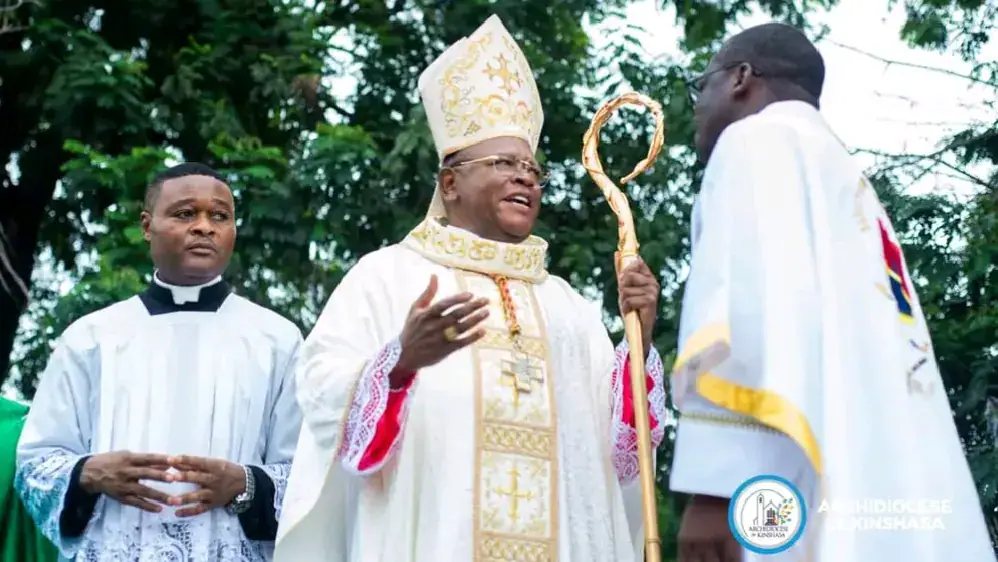
The Catholic Church in the Democratic Republic of Congo has expressed frustration and disappointment over the sudden cancellation of a youth gathering at Kinshasa's Tata Raphaël stadium. Cardinal Fridolin Ambongo, the Archbishop of Kinshasa, stated that the event, which had been authorized by the government, was abruptly canceled without a valid reason. The cardinal accused the government of provoking the Church and questioned what benefits the government hoped to gain from such actions.
According to Cardinal Ambongo, the Archdiocese had obtained all necessary permits from the Ministries of Youth and Interior two months prior to the event. The police had also been instructed to provide security for the gathering. However, on the eve of the event, the organizers were informed that the ceremony had been canceled. This decision sparked anger and confusion within the Catholic community, with many questioning the government's motives.
The event was eventually relocated to a smaller venue, the Saint-Raphael College, where hundreds of young people gathered despite the more cramped conditions. Cardinal Ambongo praised the determination of the young people, who had traveled from various parishes across the archdiocese, and encouraged them to remain calm and faithful in the face of adversity. He emphasized that the Catholic youth were not a violent group and should not be provoked into action.
The cardinal's criticism of the government reflects a broader concern about the relationship between the state and the Catholic Church in the DRC. The Church has long been a vocal advocate for peace, justice, and human rights in the country, and its leaders have not hesitated to speak out against government actions they perceive as unjust or oppressive. In this case, Cardinal Ambongo challenged the government to justify its decision to cancel the event and to take responsibility for ensuring public safety.
The incident has sparked a wider debate about the role of the Catholic Church in Congolese society and the limits of government authority. Some observers see the government's actions as an attempt to intimidate or silence the Church, which has been a vocal critic of government corruption and abuse of power. Others argue that the government is simply trying to maintain order and stability in a country still plagued by conflict and insecurity.
Cardinal Ambongo's comments also reflect a deeper concern about the polarization of Congolese society and the growing tensions between the government and civil society. The DRC has experienced significant turmoil in recent years, including violent protests, allegations of electoral irregularities, and ongoing conflict in the eastern regions. In this context, the Catholic Church's advocacy for peace, dialogue, and human rights is seen as a crucial stabilizing force.
The controversy highlights the complex and often fraught relationship between the government and the Catholic Church in the DRC. While the Church has traditionally played a significant role in promoting social justice and human rights, the government has sometimes viewed its activities with suspicion or hostility. As the country prepares for future elections and continues to navigate its complex development challenges, the relationship between the government and civil society will remain a critical issue.
Key points
- The DRC government abruptly canceled a Catholic youth gathering at Kinshasa's Tata Raphaël stadium, prompting criticism from Cardinal Fridolin Ambongo.