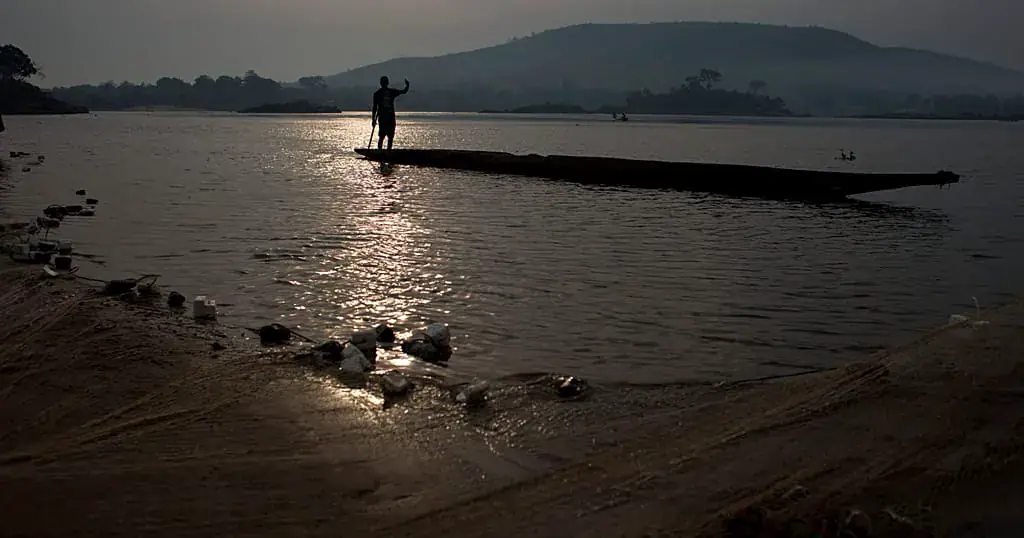
The Central African Republic has increased health screening along its river border with the Democratic Republic of Congo in response to the growing Ebola outbreak in the neighbouring country. The move aims to prevent the spread of the virus, which has already infected over 10,000 people in the DR Congo. Health workers are raising awareness among local communities at the M'Poko Bac pier frontier post in Bangui, the capital of CAR.
At the M'Poko Bac pier, health workers are implementing a rigorous screening process for passengers arriving by canoe. The process includes directing passengers to a hand-washing station, briefing them on the situation, and then conducting temperature checks and registration. Maldiana Bagalama, responsible for health screening at the site, explained the procedures in place to ensure that passengers are aware of the risks and take necessary precautions.
The porous and largely unmonitored frontier between the DR Congo and CAR stretches over 1,500 kilometres, posing a significant risk of the virus spreading. Dr Valentin Nebanga, head of the Health Promotion Department at the Ministry of Health, noted that communities on both sides of the border have close ties, leading to frequent movement of people and goods. This has raised concerns about the potential for Ebola to spread rapidly.
Despite the risks, economic activity continues along the Oubangui river, which connects the two countries. Fishermen, canoe operators, and sellers of fresh fish rely on the waterway for their livelihoods. However, this has also raised concerns about the potential for the virus to spread through trade and travel. Neige, a fishmonger and mother-of-three, expressed worries about the risk of Ebola reaching her community.
The Central African authorities have insisted that they have toughened their border controls in response to the growing threat. Health workers, the Water and Forests Department, Customs, Civil Protection, and Internal Security Forces are now staffed at entry points. All passengers, both arriving and departing, are systematically screened by community health workers. The authorities have also launched awareness-raising campaigns to educate residents on prevention guidelines.
The Central African authorities are working to keep the public engaged and informed about the importance of protective measures. Neighbourhood chiefs, community leaders, and religious figures are being drafted in to pass on prevention guidelines to residents. Dr Nebanga emphasized the importance of preparedness and community engagement in preventing the spread of Ebola.
While the CAR has not reported any Ebola cases yet, residents are growing increasingly concerned about the risks. For those who rely on river transport, fishing, or trade, avoiding travel is not always an option. Dr Nebanga acknowledged that retaining staff and keeping them engaged would be a significant challenge, while also conceding that the authorities are "never fully prepared" for the risks posed by Ebola.
Key points
- The Central African Republic has increased health screening along its river border with the DR Congo in response to the growing Ebola outbreak.
- The porous frontier between the DR Congo and CAR poses a significant risk of the virus spreading.
- The authorities have launched awareness-raising campaigns to educate residents on prevention guidelines.