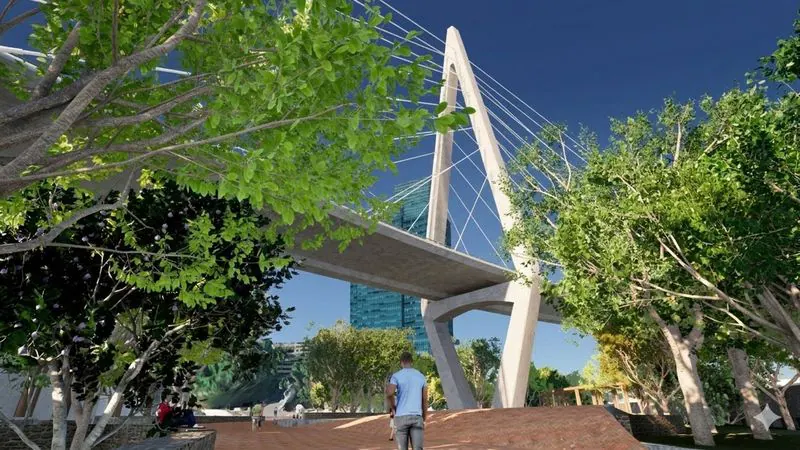
The City of Cape Town has unveiled plans to replace its unfinished Foreshore freeways with a new bridge and tunnel, while unlocking 15 hectares for housing, public space, and a new neighbourhood. The proposed bridge would link the inbound freeway directly to Helen Suzman Boulevard, bypassing Buitengracht Street below. The outbound freeway would be placed in an underground tunnel alongside Duncan Road. Mayor Geordin Hill-Lewis described the plan as the end of "50-year-old unfinished business".
The unfinished Foreshore Freeway Bridge has become an unlikely city icon, featuring in films and stunt scenes. Construction began in the early 1970s on a bridge intended to connect the CBD with the coastal areas, but the project was halted due to funding constraints. The unfinished highways are known colloquially as "Solly's Folly" after Solly Morris, the city engineer in the 1970s. Hill-Lewis stressed that the project would ease congestion while unlocking investment, jobs, and more affordable homes.
The announcement came with fanfare from the City, but for Good party secretary-general and Cape Town mayoral candidate Brett Herron, the unanswered questions are as significant as the vision itself. Herron challenged the DA-led administration to spell out the cost, funding model, construction timeline, Transnet's position on port land, and how many affordable homes will be delivered. Without those answers, Herron described the announcement as "hollow election-linked puffery".
The project would be delivered in two phases to limit disruption to traffic. The first phase would involve a new bridge over Buitengracht Street and improvements to the inbound freeway, linking it directly to Helen Suzman Boulevard. The second phase would introduce an outbound link and underground tunnel, paving the way for the eventual removal of the existing outbound elevated freeway. This would unlock the bigger prize: extending the CBD towards the harbour, creating new streets and public spaces, and opening land for residential development.
Hill-Lewis envisioned the Foreshore becoming more than a route through the city – a new neighbourhood where walking, cycling, and public transport are central to how people move around. The City has released drawings for public consultation, which will then move through detailed engineering, funding, procurement, and construction. The financial burden of the Foreshore Precinct Project is already emerging as a key question, with Hill-Lewis indicating that the city intends to shoulder the full cost of the first phase.
Transnet and the national government are expected to help finance the second phase, but the exact cost and funding model remain unclear. Construction of the first phase will only begin during the next municipal council term, following the 2026 local government elections. Herron argued that much of the vision revives a decade-old proposal abandoned after the City's 2017/18 process under the then mayor, Patricia de Lille.
The new proposal differs significantly, including an underground outbound route and the eventual removal of the existing elevated freeway. However, the City has yet to disclose a final cost or funding model, leaving many questions unanswered. Key aspects of the plan include relieving inner-city congestion, fixing the connection between the foreshore and Atlantic Seaboard, and unlocking a new vibrant Foreshore neighbourhood with affordable housing and public spaces.
Key points
- The City of Cape Town plans to replace the unfinished Foreshore freeways with a new bridge and tunnel.
- The project aims to ease congestion, unlock investment, jobs, and more affordable homes.
- The cost, funding model, and engineering risks of the project remain unclear.