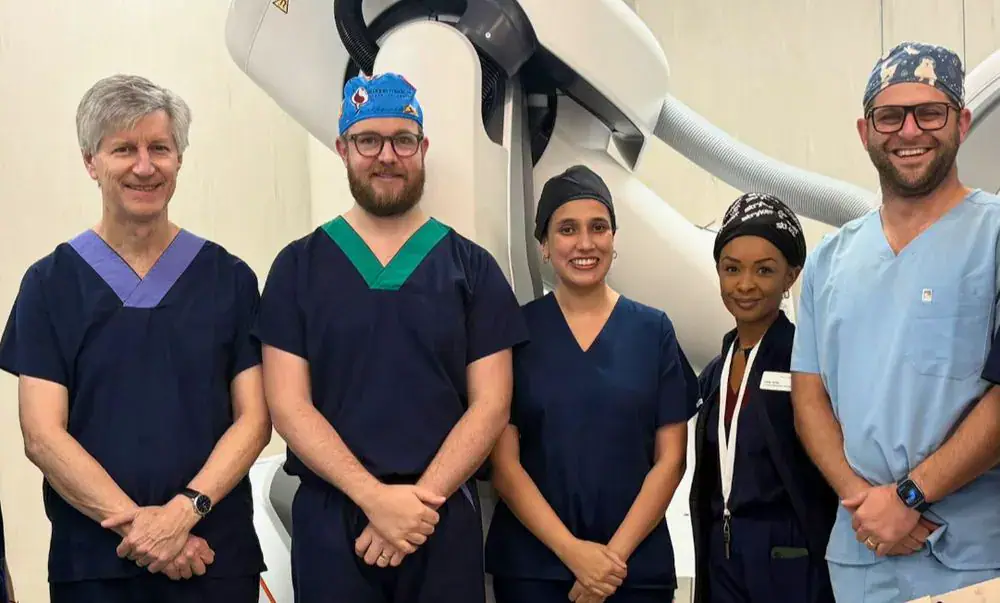
A team of specialists at Mediclinic Constantiaberg in Cape Town is set to perform a groundbreaking procedure for epilepsy patients in South Africa. On Monday, the multidisciplinary team will conduct the first stereo-EEG (SEEG) procedure in the country and sub-Saharan Africa. The procedure aims to help patients with epilepsy whose seizures cannot be controlled with medication. The team, led by epileptologist Dr Aayesha Soni, includes Dr James Butler, Dr Sean Tromp, Charné Harker, and Sebastian Wessels.
The first patient to undergo the SEEG procedure is a 43-year-old man whose seizures began about a year ago. Despite trying several anti-seizure medications, his seizures have continued, affecting his work, family life, and ability to drive. The SEEG procedure involves placing fine electrodes deep inside the brain to locate the exact area where seizures start. This information can then be used to offer surgery to patients who have not responded to medication. According to Dr Soni, this patient is an ideal candidate for the procedure.
Epilepsy affects around 50 million people worldwide, with nearly 80% living in low- and middle-income countries. In sub-Saharan Africa, epilepsy is more common than in Europe, Asia, or North America, yet many people who need treatment do not receive it. Stigma and myths about epilepsy being contagious or a sign of moral failing prevent people from seeking help. The SEEG procedure is an international standard for locating seizure origins in patients being considered for epilepsy surgery.
The SEEG procedure provides a three-dimensional picture of a person's epilepsy, allowing doctors to identify the area that can be removed to stop seizures. The procedure involves planning the path of each electrode in advance to avoid blood vessels and vital structures. In theatre, a stereotactic frame fixed to the patient's head guides the neurosurgeon to place each electrode with millimetre accuracy. The electrodes are then removed without a second operation.
The team at Mediclinic Constantiaberg has spent over a year preparing for the SEEG procedure. The process involved training, sourcing specialised equipment, writing protocols, and securing funding approvals. The team includes epileptologists, neurosurgeons, neurophysiologists, EEG technologists, neuropsychologists, radiologists, anaesthetists, and theatre and ward nurses. Dr Soni emphasised that nobody performs this procedure alone and that every person involved has spent months preparing.
Until now, South Africans who needed SEEG had to travel abroad, making it inaccessible to most people. Having the skills and team in place changes this and sends an important message that epilepsy is a medical condition that can be investigated and treated. Dr Soni believes that every time they show that epilepsy can be treated, they chip away at the stigma associated with the condition.
The next step for the team is to ensure that this care is not only available to a few but to all people with epilepsy, regardless of their location or financial means. Dr Soni added that people with epilepsy deserve the best care, and it is essential to make this care accessible to all. The SEEG procedure is a significant development in the treatment of epilepsy in South Africa and Africa.
Key points
- The SEEG procedure is an international standard for locating seizure origins in patients being considered for epilepsy surgery.
- Epilepsy affects around 50 million people worldwide, with nearly 80% living in low- and middle-income countries.
- The team at Mediclinic Constantiaberg has spent over a year preparing for the SEEG procedure.