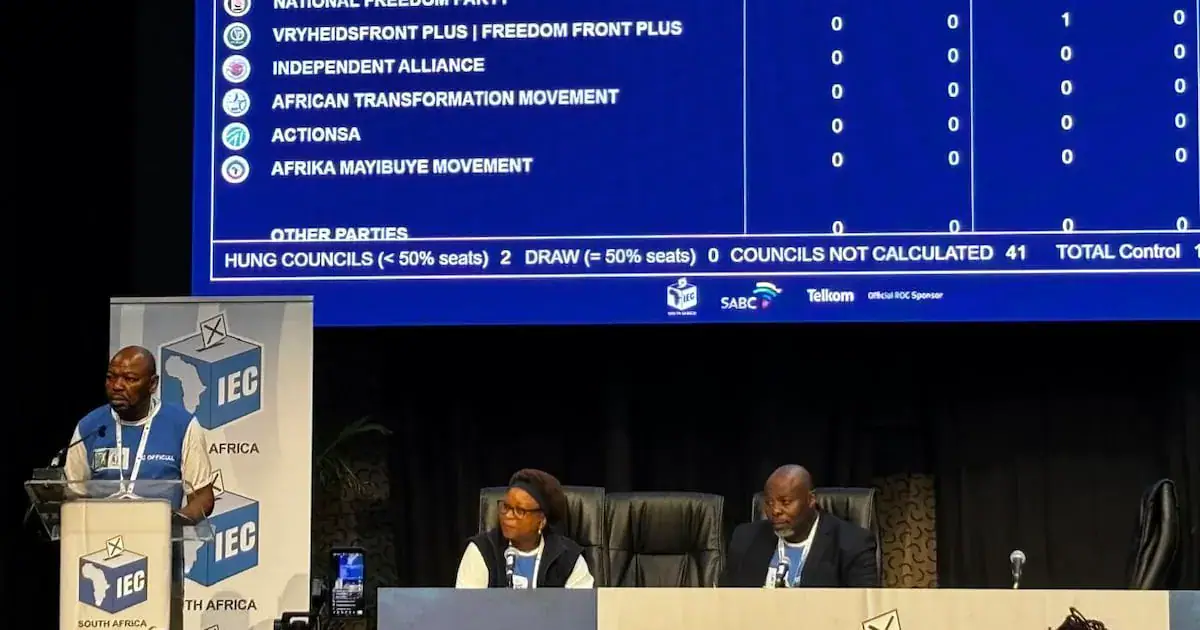
The Electoral Commission of South Africa (IEC) has ordered recounts in five wards as it processes 197 objections lodged by political parties and candidates after the 2026 local government elections. IEC chairperson Mosotho Moepya stated that 54 objections had been dismissed, while others had been withdrawn. The recounts were prompted by concerns over the outcome of the results. Moepya revealed that two objections had been upheld, indicating that they had a material impact on the result.
According to the IEC, the ANC is leading nationally with 30.8% of the votes, followed by the DA with 24%. The results are based on 99% of the votes counted. In Cape Town, the DA received 56.42% of the votes, while the ANC received 13.95%, making it the first metro to achieve a majority. The outcome in Cape Town marks a significant development in the election results.
ANC secretary-general Fikile Mbalula described the party's performance in the 2026 local government elections as "catastrophic," despite the ANC still leading nationally. Mbalula stated that the party was aware of the challenging outcome, with internal polling suggesting the party could receive at least 34% support. He emphasized that the party would not rush into coalition negotiations, prioritizing a thorough assessment of the results across municipalities.
The election results have also revealed that Buffalo City in the Eastern Cape is the fourth hung council in the country, with the ANC leading at 41.93%, followed by the UDM at 18.39%, and the DA at 16.85%. The results for three other metros are still outstanding. The IEC is continuing to update the results, with 99% of the voting results in, showing the ANC with 30.91% support nationally, followed by the DA at 24.59%, and the MKP with 9.6% of the votes.
EFF leader Julius Malema described his party's performance in the 2026 local government elections as a "setback" but not a "defeat." Malema stated that the EFF had lost 612,326 votes nationally and its third-place position, now occupied by the Jacob Zuma-led MK Party. He emphasized that the EFF remains a "people's movement" and will use the lessons from these elections to prepare for the upcoming national and provincial elections in 2029.
The UDM also made significant gains in the Eastern Cape, with national chairperson Yongama Zigebe stating that the party focused 80% of its resources on the region. The party prioritized communities that were neglected by the ANC, aiming to build people-centered services. The outcome in the Eastern Cape highlights the shifting dynamics in the region.
As the election results continue to unfold, Tshwane has no outright winner, and the results for other metros are still outstanding. The IEC will continue to update the results, and parties will likely engage in coalition negotiations to form municipal governments. The final outcome of the elections will have significant implications for the country's governance and service delivery.
Key points
- The DA achieved a majority in Cape Town with 56.42% of the votes.
- The ANC leads nationally with 30.8% of the votes.
- Recounts have been ordered in five wards due to objections lodged by political parties and candidates.