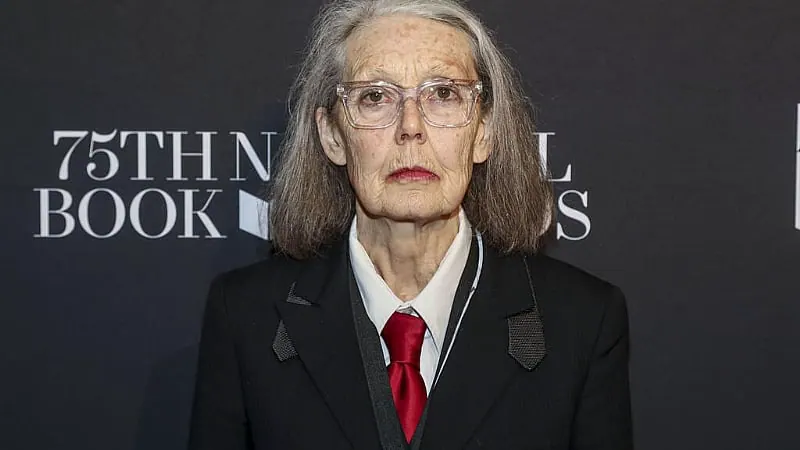
The Swedish Academy announced on Thursday, October 8, 2026, that Canadian poet and essayist Anne Carson had won the Nobel Prize in Literature. The academy cited her "bold and inventive oeuvre that, in playful dialogue with the classical tradition, has created new forms for contemporary literature". Carson, born in Toronto, draws on themes and stories from ancient Greek and Roman literature for works that often blend elements of poetry, essay, and fiction.
Ingrid Carlberg, permanent secretary of the Swedish Academy, said Carson was in Iceland "listening to the wind" when the academy reached her to notify her of the win. Carlberg added that Carson was very taken by surprise. Carson's books include "Eros the Bittersweet", a look at the pleasure and pain of desire in ancient Greek literature, verse novel "Autobiography of Red", and "Men in the Off Hours", a collection of poetry and prose that won Canada's Griffin Prize for poetry in 2001.
Carson's works often explore the intersection of classical literature and contemporary themes. Her book "Norma Jeane Baker of Troy" compares Marilyn Monroe and Helen of Troy, while her translations of classical Greek literature, such as "If Not, Winter" and "Bakkhai", have been regarded as independent works in their own right. The Swedish Academy praised Carson's ability to create new forms for contemporary literature while engaging with the classical tradition.
Anders Olsson, chair of the literature committee, noted that Carson's literary production has centered upon the intersection between the philologist's obsession with words and the poet's desire for new meaning. Carson has taught classics at several North American universities and has lived in Iceland, where she and her husband, Robert Currie, were granted citizenship in 2022.
The Nobel Prize in Literature was announced by the Swedish Academy in Stockholm. The prize money this year is 12 million Swedish kronor, approximately $1.2 million. Carson's win follows that of Hungarian writer Laszlo Krasznahorkai, who won the prize last year for his surreal and anarchic novels that combine a bleak world view with mordant humour.
This week's Nobel announcements began with the prize for medicine, which went to three scientists whose work led to a tool that uses light to help unravel how the brain works. The physics award recognised a scientist's efforts to demystify a rare group of neutrinos, while the chemistry prize recognised two scientists for untangling mysterious mirror images in molecules.
The Nobel Memorial Prize in Economic Sciences will be announced on Monday, and the peace prize will be announced on Friday. Carson's win marks a significant recognition of her contributions to literature, and her unique blend of classical and contemporary themes has been widely praised.
Key points
- Anne Carson won the Nobel Prize in Literature for her bold and inventive works that blend classical tradition with contemporary literature.