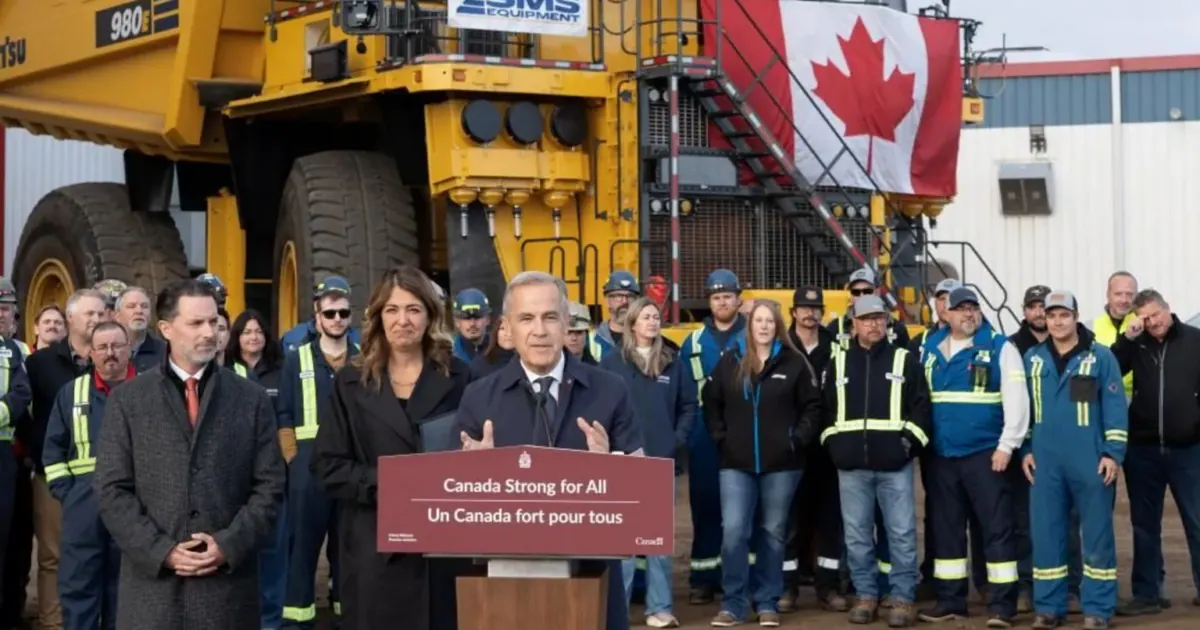
Canadian Prime Minister Mark Carney has announced plans to expedite the approval process for the Pacific Link oil pipeline project. The 1,250km pipeline will connect Bruderheim, Alberta, to a deep-water port near Delta, British Columbia. Carney argues that the project is crucial for Canada's national interests, allowing the country to diversify its oil markets and reduce its dependence on the US. Currently, Canada sends 90% of its crude oil exports to the US.
The Pacific Link project is expected to have a significant impact on Canada's economy, boosting GDP by up to C$30bn per year and creating 140,000 jobs. The pipeline will be capable of carrying approximately one million barrels per day of crude oil, which will be shipped by boat to global markets. The project includes the construction of marine berths able to accommodate vessels that can carry up to two million barrels' worth of oil.
The pipeline project is seen as a strategic move by Canada to reduce its vulnerability to US protectionist tariffs. Carney aims to turn Canada into a global energy "superpower" and has promised global investors that Ottawa can move quickly to build major projects. The project will be the first to have its federal approvals and regulatory reviews fast-tracked under a new law put in place last year by the Liberal government.
The Pacific Link project has already garnered support from the governments of Canada and Alberta, as well as the Pembina Pipeline Corporation, which has a non-binding agreement for a 10% stake. A minimum of a 10% ownership stake will also be offered for purchase to indigenous groups. The project is expected to cost between C$35.2bn and C$43.7bn and may face pushback from environmental groups and some indigenous communities.
Carney has emphasized that discussions with many indigenous communities have already taken place, with "intensive" consultations to come. The plan is for construction to begin by 2032 if it receives final approval. As part of the agreement, Alberta has agreed to develop the world's largest carbon capture programme in a bid to reduce its overall emissions.
The Canadian government has worked to shore up ocean protection funding and rules to protect marine life that could be affected by increased coastal tanker traffic. The project is also seen as a demonstration of Canada's commitment to its western province, Alberta, which has long argued that it has been hampered from developing its resources. Albertans will vote later this month in a referendum on independence.
The pipeline project is likely to face scrutiny from environmental groups, particularly over concerns about the impact on coastal marine health. However, Carney remains optimistic that the project will move forward as planned, which could attract more private investment and demonstrate Canada's ability to handle large-scale projects efficiently.
Key points
- The Pacific Link oil pipeline project aims to reduce Canada's dependence on the US by diversifying its oil markets.
- The project is expected to boost Canada's GDP by up to C$30bn per year and create 140,000 jobs.
- The pipeline project will be the first to have its federal approvals and regulatory reviews fast-tracked under a new law put in place last year by the Liberal government.