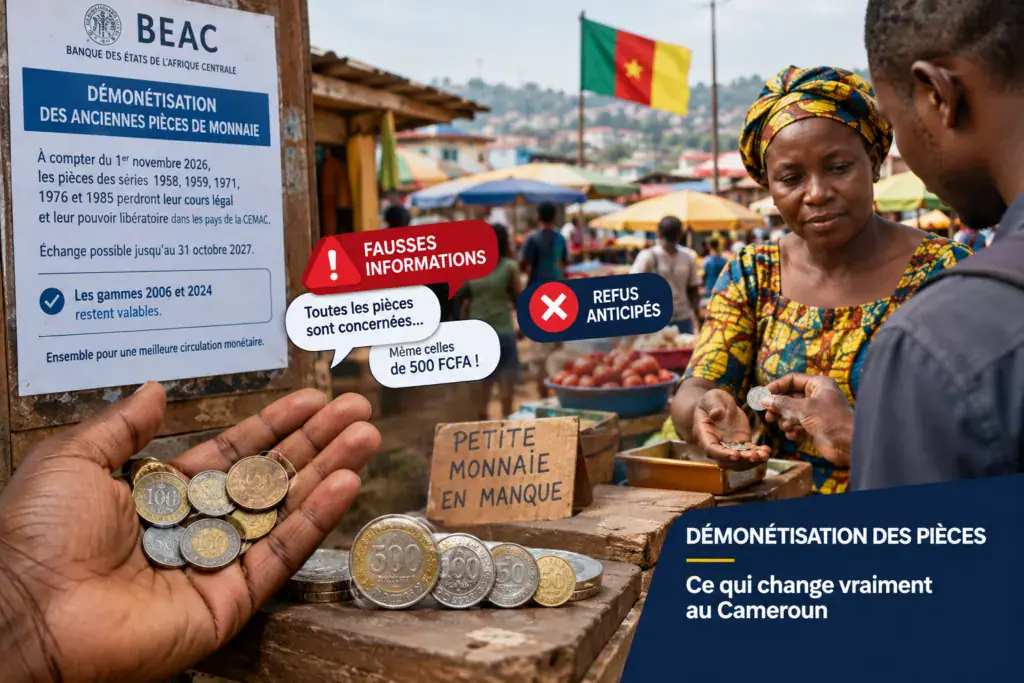
The Committee of Ministers of the Central African Economic and Monetary Community (CEMAC) announced on October 7, 2026, in N'Djamena, Chad, that certain coins minted in 1958, 1959, 1971, 1976, and 1985 would lose their legal tender status and be demonetized in six CEMAC countries, including Cameroon. This decision has caused widespread confusion and misinformation among the public, with many believing that all coins of certain denominations, such as 500 FCFA and 100 FCFA, would become invalid.
However, the BEAC has clarified that not all coins in circulation are affected, and coins minted in 2006 and 2024 remain valid. The demonetized coins can be exchanged for new ones during a transitional period. According to the BEAC, the demonetization process involves the official withdrawal of a banknote or coin from circulation, after which it can no longer be used to pay for goods and services. The exchange period has been divided into three stages, with the first stage running from November 1, 2026, to July 31, 2027, during which time banks, microfinance institutions, and the BEAC will exchange the old coins.
Economists have attributed the confusion surrounding the demonetization to the technical vocabulary used and the information disseminated about the exchange calendar. Dany Dombou, an economist, noted that the announcement was made in two stages, and the use of terms like "legal tender" and "liberatory power" may have caused some people to anticipate and refuse the old coins. Dr. Aristide Merlin Ngono, an economist from the Association of Economists and Managers of Cameroon, emphasized that the loss of legal tender does not necessarily mean the loss of value, and that the old coins can still be exchanged for new ones during the transitional period.
The transition could potentially complicate payments if new coins are not available in sufficient quantities. Dr. Ngono noted that Cameroon is already experiencing a chronic shortage of small change, which could lead to price increases and difficulties in making change. He suggested that the lack of small change could lead to price rounding, where prices are increased to the nearest larger denomination. For example, an item priced at 150 FCFA could be rounded up to 200 FCFA.
Economists have proposed several measures to mitigate the challenges associated with the demonetization, including public education campaigns, the deployment of mobile exchange offices, and the display of information about the affected coin denominations in markets. Dany Dombou advised holders of demonetized coins to verify their minting year and exchange them as early as possible, preferably before July 31, 2027, and to avoid accepting any discounts offered by intermediaries.
The success of the demonetization process will depend on its impact on the circulation of money and the exchange conditions for users. Dr. Ngono identified several indicators that will be used to evaluate the outcome of the operation, including the rate of return of demonetized coins, the availability of small change, and the acceptance of valid coins. He emphasized that it is essential to avoid a significant decrease in the availability of small change and to minimize price increases due to rounding.
The demonetization of certain coins in Cameroon and other CEMAC countries highlights the need for effective communication and education to prevent confusion and misinformation. The BEAC and governments of the affected countries must work together to ensure a smooth transition and minimize disruptions to economic activity. By providing clear information and adequate exchange facilities, the authorities can mitigate the challenges associated with the demonetization and ensure that the process is successful.
Key points
- The demonetization of certain coins in Cameroon and other CEMAC countries will take effect on November 1, 2026.
- The affected coins can be exchanged for new ones during a transitional period.
- Economists have warned that the transition could complicate payments if new coins are not available in sufficient quantities.