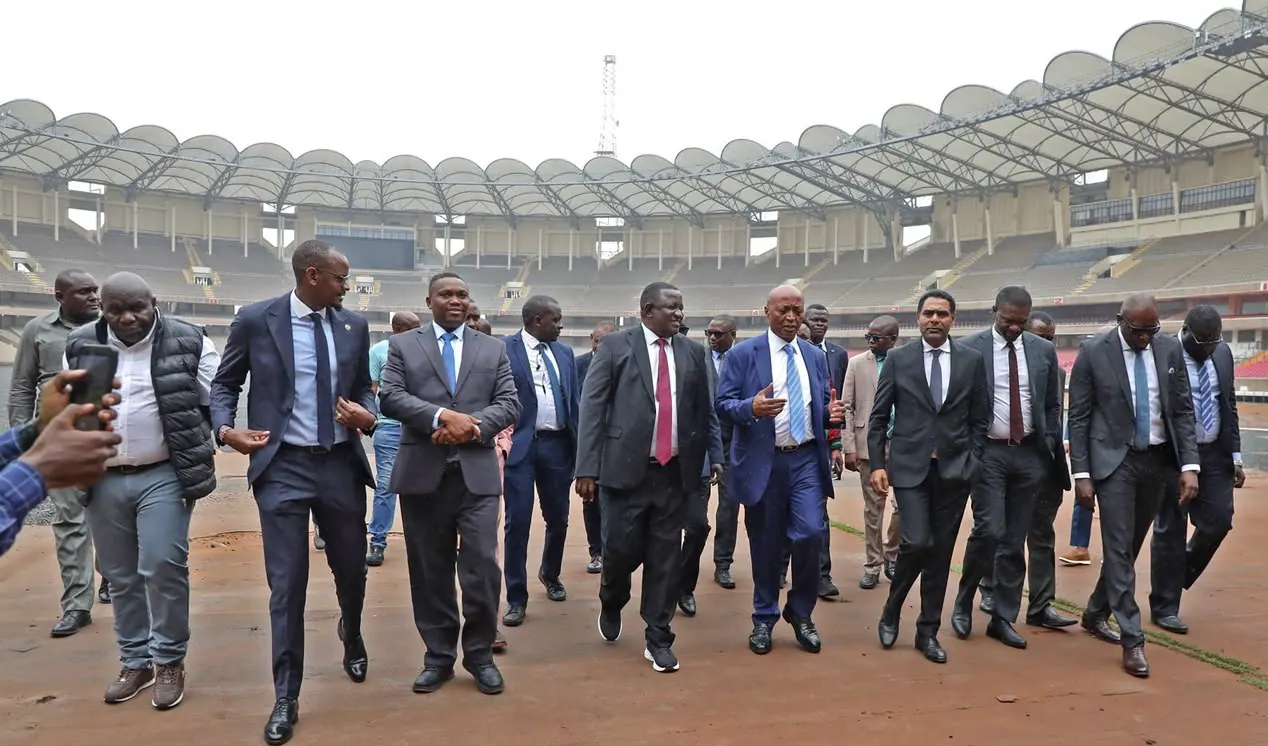
The Confederation of African Football (CAF) has expressed confidence in the 2027 Africa Cup of Nations (AFCON) hosting arrangements, despite growing concerns over infrastructure preparations in co-host countries Kenya, Tanzania, and Uganda. With the tournament set to kick off on June 19, 2027, CAF president Patrice Motsepe has urged the hosts to develop a "heightened sense of urgency" in their preparations. This follows recent inspections in Tanzania and Kenya, where Motsepe assessed progress and emphasized the need for timely completion of outstanding construction and technical requirements.
During his inspection visits, Motsepe acknowledged considerable progress but noted that some venues remained below the required standard. In Kenya, the newly constructed 60,000-capacity Talanta Sports City Stadium received positive feedback, while Kasarani Stadium in Nairobi and its associated training facilities require further work. Concerns include the playing surface, broadcast cabling, floodlights, and VIP facilities at Kasarani. Kenya's Cabinet Secretary for Sports, Salim Mvurya, has pledged to accelerate work and complete preparations by December, allowing for test matches before CAF's January assessment.
The January deadline is critical, as it allows for the testing of stadiums, training grounds, hotels, transport systems, and security arrangements under realistic matchday conditions. CAF's concern extends beyond mere construction completion, focusing on operational, safe, and reliable facilities. This emphasis on readiness is informed by past experiences, including the African Nations Championship (CHAN) in February 2025, which was postponed due to inadequate stadium and facility standards in the host countries.
The CHAN tournament, reserved for players competing in domestic leagues, was eventually held in August 2025, providing the three countries with an opportunity to complete necessary work and gain experience in hosting a CAF competition. Motsepe has cited this episode as evidence of what can be achieved through cooperation and flexibility, while dismissing reports of potential AFCON 2027 relocation. He has stressed that there is "not the slightest consideration of a postponement," emphasizing the need for measurable progress.
Each co-host country faces unique infrastructure challenges. In Kenya, preparations focus on Nyayo Stadium, Kasarani Stadium, and Talanta Sports City Stadium in Nairobi. Uganda's preparations center on Mandela National Stadium in Kampala, Akii-Bua Olympic Stadium, and Hoima City Stadium, with the Local Organising Committee expecting all three stadiums to be ready by December 2026. Tanzania has identified Dar es Salaam, Arusha, Dodoma, and Zanzibar as host locations, with CAF inspecting stadiums, training venues, hotels, airports, and other support facilities.
The inspections reflect the broader operational demands of hosting a tournament across multiple cities. With the January deadline looming, the co-hosts must address technical shortcomings and ensure facilities meet CAF requirements. Motsepe's message is twofold: confidence in the hosting arrangement remains, but it does not obviate the need for tangible progress. The CAF president has called on the hosts to act with urgency, warning that stadiums must be ready for testing by January 2027.
As the tournament approaches, the co-hosts must balance their preparations with the need for cooperation and flexibility. With considerable work remaining, Kenya, Tanzania, and Uganda must work to complete outstanding construction, address technical requirements, and ensure that facilities are operational, safe, and reliable. The success of AFCON 2027 depends on their ability to meet the January deadline and deliver a world-class tournament.
Key points
- CAF president Patrice Motsepe has urged co-hosts Kenya, Tanzania, and Uganda to develop a "heightened sense of urgency" in their AFCON 2027 infrastructure preparations.
- The January 2027 deadline is critical for stadium readiness and testing under realistic matchday conditions.
- Each co-host country faces unique infrastructure challenges, with Kenya, Uganda, and Tanzania working to complete outstanding construction and technical requirements.