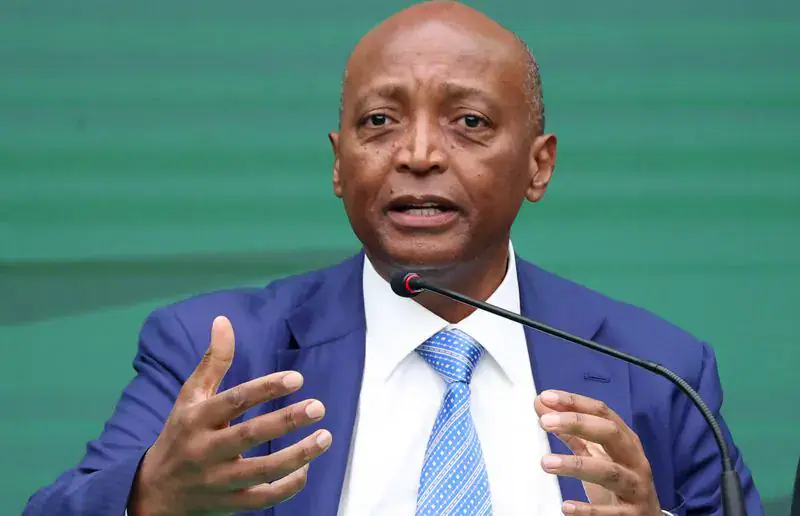
The Confederation of African Football (CAF) has announced that it will revert to the traditional two-year cycle for the Africa Cup of Nations (Afcon), Africa's premier soccer competition. This decision comes after CAF's executive committee vetoed a previous announcement that the Afcon would take place every four years. CAF President Patrice Motsepe stated that the motivation behind this change is financial.
The previous decision to hold the Afcon every four years was made in 2025, with the aim of aligning it with other continental competitions such as the European Championship and South America's Copa America. However, CAF has now reassessed this decision, citing the need to advance, protect, and promote the interests of African football and its 54 member associations.
According to Motsepe, the decision to hold the Afcon every two years was based on the recognition that the proposed African Nations League would require several years to contribute substantial financial resources necessary to keep African soccer globally competitive and self-supporting. The African Nations League, which was set to start in 2029, was conceived to reduce the number of dead-rubber international friendlies.
The next Afcon is scheduled to take place in 2027, co-hosted by Kenya, Tanzania, and Uganda, from June 19 to July 17. Despite some reports suggesting that the hosts' infrastructure may not be ready, CAF is confident that the tournament will take place on time. Motsepe expressed his confidence in the success of the 2027 Afcon.
The decision to revert to a biennial Afcon cycle also takes into account the scheduling of future tournaments. Motsepe stated that subsequent Afcons will take place in 2028, 2031, and 2033. The forthcoming FIFA World Cup is set to take place in 2030, and CAF will consider this when scheduling future Afcon tournaments.
The previous announcement of a quadrennial Afcon was met with criticism, with some accusing Motsepe of pandering to European interests. FIFA President Gianni Infantino had lobbied for Afcon to shift to a four-year cycle, suggesting that Africa move its schedule to align with other continental competitions.
Motsepe has denied that CAF is bowing down to European pressure, stating that the organization is convinced that it is doing what is best for African football. The decision to hold the Afcon every two years has been endorsed by CAF's executive committee, which believes that this is the best option for African soccer.
Key points
- Financial considerations were the primary motivation behind CAF's decision to revert to a biennial Afcon cycle.
- The next Afcon is scheduled to take place in 2027, co-hosted by Kenya, Tanzania, and Uganda.
- CAF has denied that the decision to hold the Afcon every two years was influenced by European pressure.