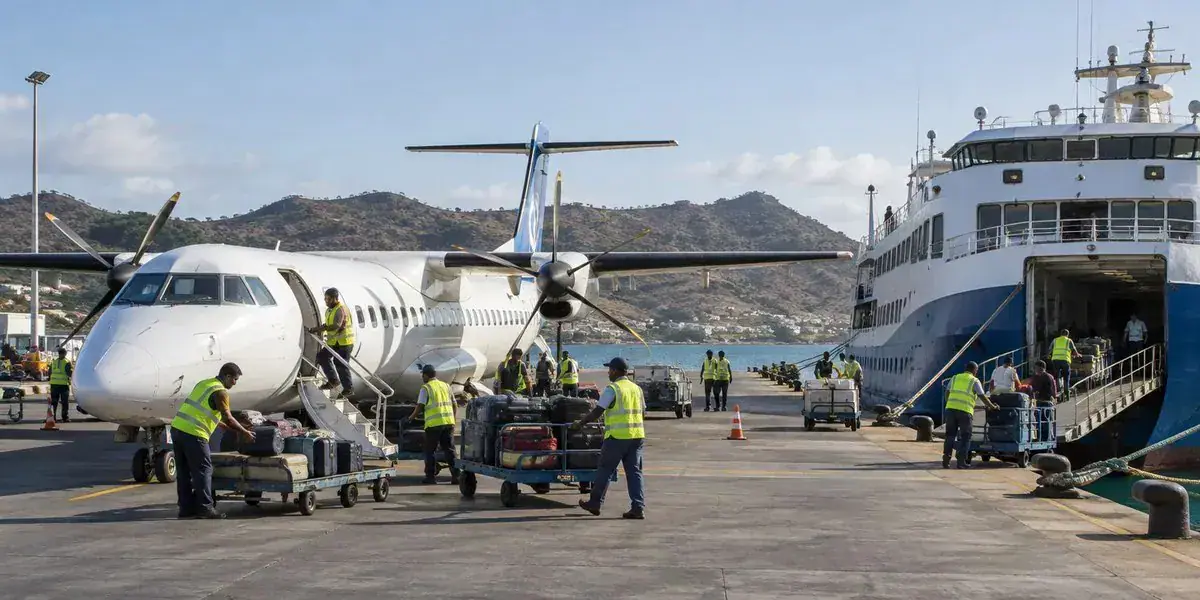
The government of Cabo Verde has announced a transport reform plan to integrate domestic and international flights with maritime services, aiming to create a coordinated and investable system. The plan was unveiled by Transport Minister João do Carmo at the inauguration of Transportes Aéreos de Cabo Verde's new board, led by Mário Almeida. This move is crucial for Cabo Verde, given its geography as a scattered archipelago.
The reform seeks to establish a whole-system framework linking domestic flights, international routes, and ferry services. This will involve coordinated schedules and joint purchasing across shared operating platforms for all modes of transport. The government wants to keep the markets for domestic and international services distinct, with revenues, costs, and obligations accounted for separately. This approach aims to improve access for residents and strengthen tourist route reliability.
Currently, TACV operates international services under the Cabo Verde Airlines brand, while Linhas Aéreas de Cabo Verde, trading as CVsky, runs domestic routes. Airport management is under a 40-year concession held by Cabo Verde Airports S.A., a VINCI Airports subsidiary. Ground handling and air navigation services are also within the scope of the reform. The government plans to implement a flat inter-island airfare of 5,000 Cape Verdean escudos, roughly €45, from January 2026.
The new fare policy requires public rules, confirmed budget cover, and a working compensation mechanism for operators. Where the market cannot sustain minimum services, the state may contract specific frequencies, schedules, and seat allocations. This creates a potential revenue floor for operators and raises the importance of transparent procurement and timely payment systems. A recent World Bank analysis described inter-island air supply as scarce, expensive, and unpredictable.
To address these constraints, the reform emphasizes stronger coordination between public agencies and private concessionaires. The government authorised up to €4.1 million to compensate TACV under its public-service obligations, with the amount earmarked in the 2026 supplementary budget. This move highlights the importance of operating discipline as much as physical infrastructure in the reform efforts.
The government is also seeking a strategic partner for TACV, with negotiations reported to be at an advanced stage and an announcement expected shortly. The integration of air and sea services and the implementation of a flat inter-island fare are expected to improve the overall transport system in Cabo Verde. This could have a positive impact on the country's connectivity, tourism, and economy.
A lower fare can support demand, but it will not resolve weak scheduling alone. An integrated timetable must match aircraft availability and airport services. The success of the reform will depend on effective coordination and implementation. The government aims to create a more efficient and reliable transport system, which is essential for the country's development.
Key points
- The government plans to implement a flat inter-island airfare of 5,000 Cape Verdean escudos, roughly €45, from January 2026.
- The reform seeks to establish a whole-system framework linking domestic flights, international routes, and ferry services.
- The government authorised up to €4.1 million to compensate TACV under its public-service obligations, with the amount earmarked in the 2026 supplementary budget.
Reporting sources
- Cabo Verde transport reform links air and sea · FurtherAfrica