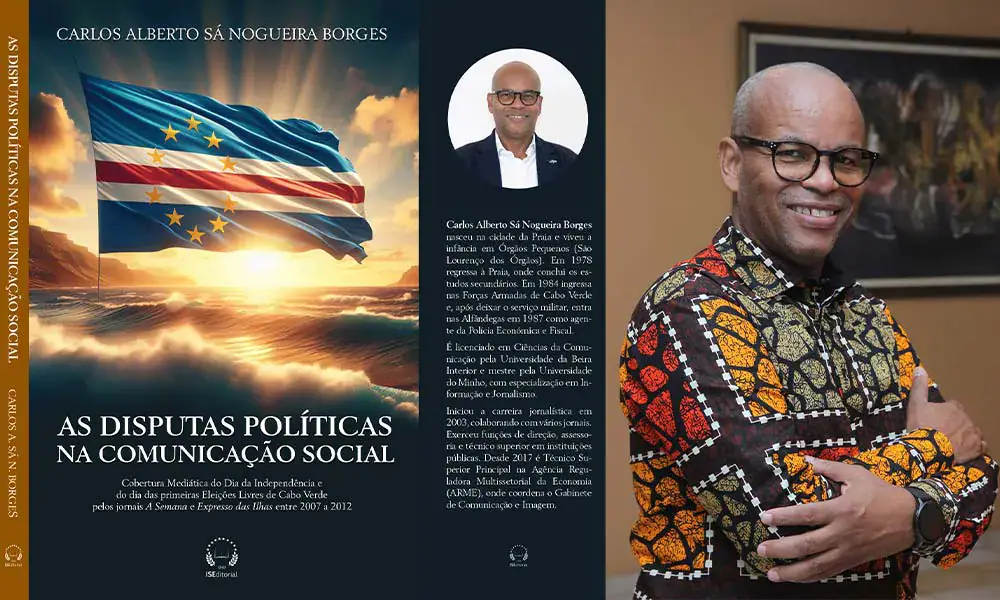
Cabo Verdean journalist and researcher Carlos Alberto Sá Nogueira Borges is set to present his book "As Disputas Políticas na Comunicação Social" (The Political Disputes in Social Communication) on Friday, November 27, in Praia. The book examines the media coverage of two significant events in Cabo Verde's history: the country's independence on July 5, 1975, and the first multiparty elections on January 13, 1991.
The book, which is based on Nogueira's master's thesis in Communication Sciences, analyzes the treatment of these events by two major Cabo Verdean newspapers, A Semana and Expresso das Ilhas, between 2007 and 2012. The author seeks to understand how these newspapers covered these events and how their narratives reflected the political polarization that characterized Cabo Verdean society after the transition to democracy.
Nogueira's research combines content analysis, critical discourse analysis, and in-depth interviews to explore the influence of political ideology on journalistic discourse. The book is prefaced by Professor João Carlos Correia of the University of Beira Interior and is seen as a significant contribution to the understanding of the role of the media in shaping the collective memory of Cabo Verde's political history.
The presentation of the book, which will be held at the University of Santiago, aims to stimulate reflection on the relationship between journalism, political power, and democracy in Cabo Verde. The event will feature comments from Professors Pedro Matos and Nardi Sousa, as well as Silvino Lopes Évora, the book's editor.
According to Nogueira, the book highlights the importance of a free, rigorous, and independent press in promoting a more informed citizenry and deepening democratic debate. He argues that journalists play an active role in shaping public discourse and that their work can contribute to a more nuanced understanding of the country's history and politics.
Carlos Alberto Sá Nogueira Borges is a native of Praia and has a background in communication sciences and journalism. He has worked as a journalist and held positions in public institutions, including the Agência Reguladora Multissetorial da Economia (ARME), where he currently serves as coordinator of the Communication and Image Office.
The book's presentation is seen as a significant event in Cabo Verde's cultural and intellectual landscape, and it is expected to generate interest among journalists, academics, and citizens interested in understanding the country's history and democratic development.
Key points
- The book examines the media coverage of Cabo Verde's independence and first multiparty elections.
- The author analyzes the influence of political ideology on journalistic discourse.
- The presentation aims to stimulate reflection on the relationship between journalism, power, and democracy in Cabo Verde.