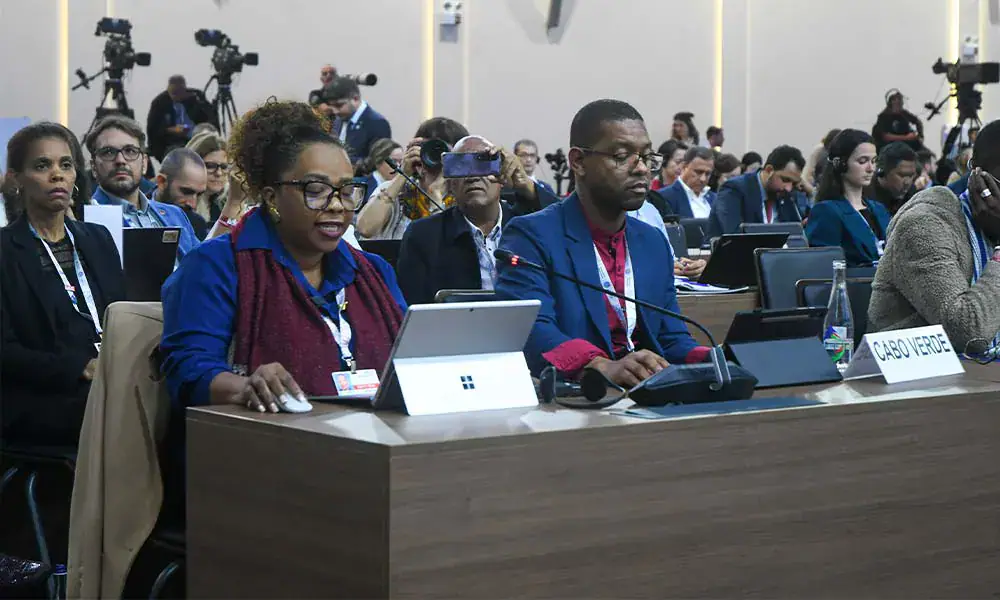
Cabo Verde has made significant progress in achieving its climate adaptation goals, surpassing 90% of the targets set out in its National Adaptation Plan to Climate Change, which runs until 2030. The announcement was made by Maria José Lopes, the country's secretária de Estado das Finanças, at a high-level event on Global Climate Action on the sidelines of the 31st United Nations Climate Change Conference (COP31) in Antalya, Turkey.
Lopes emphasized that the achievement was made possible through the involvement of national institutions, including municipalities, communities, and various partners. She highlighted that the country's vulnerability as a small island state should not determine its future, and that Cabo Verde aims to lead by example. The country has implemented various projects and mechanisms to enhance its response to climate change impacts, including the cliMAPAS CV, which provides detailed mapping of risks and vulnerabilities in 22 municipalities.
The government has also developed the Climate Portal, which provides information and consultation tools, as well as Local Climate Action Plans, designed to tailor adaptation measures to the specific needs of each territory. These mechanisms are aligned with the country's Nationally Determined Contribution (NDC 3.0), Low Emission Development Strategy, and Strategic Plan for Climate Mobilization. Lopes stressed that the next step is to translate planning and knowledge into concrete investments and projects, particularly in areas such as water security, clean energy, coastal protection, and resilient infrastructure.
Lopes emphasized that achieving these objectives requires joint action from governments, municipalities, financial institutions, companies, universities, and civil society. She also called for sufficient, accessible, and predictable climate financing, without exacerbating debt-related vulnerabilities. The country's progress in climate adaptation was highlighted at a time when Cabo Verde is set to assume the presidency of the Alliance of Small Island States (AOSIS) in January 2027.
As president of AOSIS, Cabo Verde aims to strengthen the participation of small island states in climate negotiations and the search for solutions to climate challenges. Lopes expressed her commitment to ensuring that the experience and voices of these countries translate into concrete results. She also appealed for the Global Climate Action Agenda to transform scientific knowledge into decisions and international cooperation into tangible outcomes.
The High-Level Event on Global Climate Action was convened by the presidencies of COP30 and COP31, the High-Level Climate Champions, and the executive secretary of the UNFCCC. The event brought together experiences and initiatives aimed at accelerating the implementation of climate commitments. Lopes reiterated Cabo Verde's willingness to contribute and share its experience in climate action.
The country's achievement in climate adaptation is a significant milestone, particularly in the context of its vulnerability to climate change impacts. As a small island state, Cabo Verde is highly exposed to climate-related risks, including sea-level rise, drought, and extreme weather events. The country's progress in achieving its climate adaptation goals serves as an example for other small island states and demonstrates its commitment to addressing the challenges posed by climate change.
Key points
- Cabo Verde has exceeded 90% of its climate adaptation targets, set out in its National Adaptation Plan to Climate Change.
- The country aims to lead by example, despite its vulnerability as a small island state, and has implemented various projects and mechanisms to enhance its response to climate change impacts.
- Cabo Verde will assume the presidency of the Alliance of Small Island States (AOSIS) in January 2027, and aims to strengthen the participation of small island states in climate negotiations and the search for solutions to climate challenges.