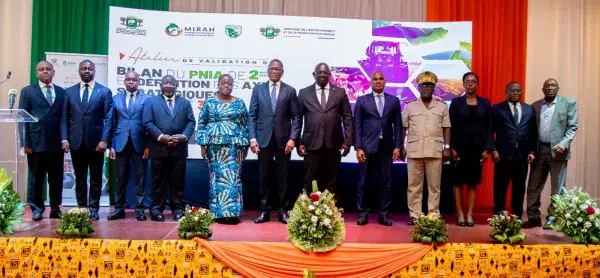
Côte d'Ivoire's Minister of Agriculture, Bruno Nabagné Koné, has announced a new direction for the country's agricultural sector with the introduction of the Programme national d'investissement agricole de troisième génération (PNIA 3). The goal is to create a more productive, resilient, competitive, and inclusive agro-food system that benefits producers while preserving natural resources. This development was made at the national validation workshop for the PNIA 2 and definition of strategic orientations for PNIA 3.
The workshop, which brings together around 250 institutional actors, professionals, and partners from the agricultural sector, aims to evaluate the achievements of PNIA 2 and define the strategic axes of PNIA 3. Minister Koné emphasized the importance of this exercise for the country's economic future, highlighting that agriculture is a strategic sector that employs nearly half of the active population, contributes almost 20% to the GDP, and represents 40% of the country's export earnings.
Since 2012, two generations of national agricultural investment programs have contributed to the structuring and modernization of the sector. PNIA 1, implemented from 2012 to 2017, improved production infrastructure, strengthened governance of agricultural sectors, and supported the development of plant, animal, and fisheries production. PNIA 2, which covered the period from 2018 to 2025, pursued this dynamic by expanding ambitions to competitiveness of sectors, agro-food transformation, and development of agropoles.
The results of PNIA 2 show notable progress, with the agricultural sector recording an average annual growth of around 4.7% over ten years, despite disruptions caused by the COVID-19 pandemic. Public investment in the sector has also increased significantly, rising from 121 billion FCFA in 2017 to 374 billion FCFA in 2024. Other indicators demonstrate this evolution, including a rise in rice yield from 2.3 to 2.94 tons per hectare and an increase in poultry production.
Despite these achievements, Minister Koné acknowledged that there are still shortcomings hindering the sector's development. The main challenge lies in the agricultural growth model, which is largely based on the extension of cultivated areas rather than improved yields. Koné warned that this model has reached its limits and emphasized the need for a new approach that prioritizes productivity, transformation, and better remuneration for producers.
The PNIA 3 will be developed in a context marked by climate change, geopolitical tensions, market volatility, and technological mutations. The new program must align with continental and regional commitments, including the Declaration of Kampala on the Detailed Program for African Agricultural Development (PDDAA) for the period 2026-2035, as well as the new orientations of the regional agricultural policy of ECOWAS.
The Minister outlined the direction for PNIA 3, which includes building a more performant agriculture based on research, innovation, mechanization, and better mastery of water. The goal is to promote an agricultural model that increases production without accelerating environmental degradation. The PNIA 3 will also need to be coherent with Côte d'Ivoire's National Development Plan (PND) 2026-2030, which prioritizes modernization of agriculture, rural land securitization, and improved productivity.
Key points
- Côte d'Ivoire aims to develop a more productive and resilient agricultural sector through the PNIA 3.