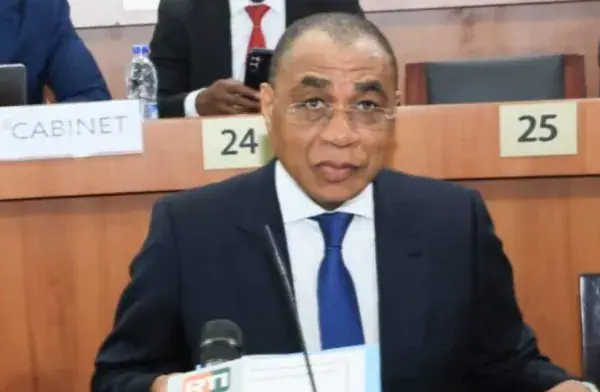
Côte d'Ivoire's Minister of Economy, Finance and Budget, Adama Coulibaly, presented the country's 2027 budget to parliament on November 10, 2026. The budget is set at 18,466.1 billion FCFA, representing a 6.4% increase from 2026. This growth reflects the government's commitment to sustaining economic development while maintaining macroeconomic stability. The budget is built around six priorities, focusing on supporting economic growth, enhancing public investments, and continuing public finance reforms.
The 2027 budget is balanced in terms of resources and expenditures. It comprises 9,385.4 billion FCFA in budget revenues and 7,399.1 billion FCFA in treasury resources. Additionally, 1,681.6 billion FCFA is allocated to special treasury accounts. According to Coulibaly, this budget aligns with the government's development ambitions while addressing international economic uncertainties and public finance pressures. The projections indicate that economic growth will be driven by dynamic investments and a 4.7% increase in final consumption.
A key aspect of the 2027 budget is the government's strategy to consolidate public finances. After an estimated budget deficit of 3.8% of GDP in 2026, the government aims to reduce this to 3.5% in 2027, with a target of reaching the 3% threshold by 2028. Coulibaly explained that the deficit was relaxed in 2026 due to international pressures but will trend downward in 2027, converging to 3% in 2028. This approach reflects the authorities' commitment to gradually strengthening budget discipline while preserving funding for investments and public policies.
The budget also focuses on improving revenue mobilization to alleviate state financing constraints. The tax pressure is expected to reach 15.5% of GDP. Furthermore, the wage bill as a proportion of tax revenues is projected to be 29.2% in 2026, below the 35% community norm. Investment allocations in the budget are significant, with 4,638 billion FCFA (25.1% of total expenditures) dedicated to this area. Social sectors such as education, training, and research will receive 21.3% of global expenditures, while health and social actions will account for 11.1%.
The defense, security, and justice sectors will receive 16.6% of expenditures, reflecting the government's commitment to simultaneously pursuing infrastructure development, human capital enhancement, and national stability. The 2027 budget aligns with the orientations of the National Development Plan (PND) 2026-2030. A total of 4,963.7 billion FCFA in budgetary and special treasury account investments will support strategic areas such as human capital development, agricultural modernization, infrastructure projects, economic transformation, and governance improvement.
Notable projects include the construction of an urban train, allocated 185.1 billion FCFA, and a rural infrastructure connectivity project, with a budget of 70 billion FCFA. These investments aim to enhance living conditions, boost economic competitiveness, and accelerate territorial development. The government also plans to improve budget execution quality, building on progress made in implementing the budget-programme system since 2020, which has led to an improved execution rate from 73.7% to 92.3% between 2020 and 2025.
The minister emphasized that these achievements demonstrate efforts to enhance public administration performance and optimize state resource utilization. The 2027 budget marks a critical phase in Côte d'Ivoire's economic development, balancing growth ambitions with fiscal discipline. As the parliamentary examination of the budget continues, its implementation will be closely monitored to ensure alignment with set objectives and to address emerging challenges effectively.
Key points
- The 2027 budget for Côte d'Ivoire is set at 18,466.1 billion FCFA, a 6.4% increase from 2026.
- The budget focuses on six priorities, including supporting economic growth and enhancing public investments.
- The government aims to reduce the budget deficit to 3% of GDP by 2028.