The Côte d'Ivoire government has reaffirmed its commitment to accelerating the industrialization of its cashew sector, with a goal of transforming over 50% of its cashew production locally by 2026. This development was announced at the closing ceremony of the 5th edition of the International Exhibition of Equipment and Technologies for Cashew Transformation (SIETTA) held in Abidjan on November 28, 2026. The country's strategy aims to stimulate investments and create new economic opportunities around cashew products.
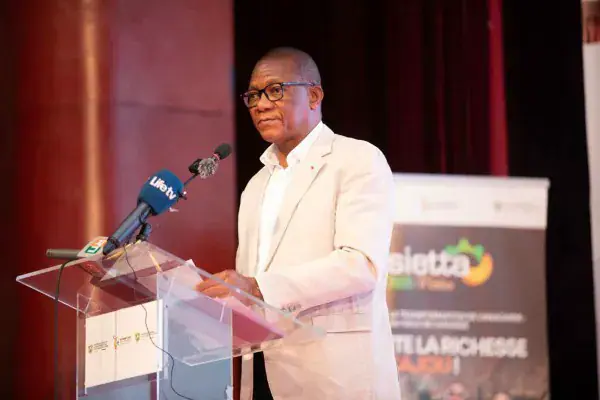
The Minister of Agriculture, Rural Development, and Food Production, Bruno Koné, praised the progress made and reiterated the government's determination to make local transformation a powerful lever for creating wealth, jobs, and added value. He recalled that the SIETTA was born out of an ambition by President Alassane Ouattara to transform locally what is produced in the country. The government aims to consolidate its gains and accelerate progress toward its national goal of 80% local transformation of cashew production.
The country's cashew sector has made significant progress, with investments in industrial infrastructure and the commitment of producers, economic operators, and thousands of workers contributing to its development. In addition to increasing local transformation capacities, Bruno Koné emphasized the need to develop a national industry capable of designing and manufacturing its own equipment. This includes the conception, manufacture, and maintenance of specialized equipment, such as decorticators, which presents opportunities for Ivoirian engineers, technicians, and skilled workers.
The 5th edition of SIETTA highlighted the largely unexplored economic potential of various cashew components. The event's theme, "Cashew Transformation Beyond the Kernel," emphasized the need to diversify products derived from the cashew sector. The cashew apple and shell offer numerous possibilities for valorization, including the production of juice, vinegar, syrup, and jam from the apple, as well as the manufacture of biochar and extraction of shell oil. This diversification can improve the profitability of farms, reduce losses, and create more added value from national production.
Mamadou Berté, Director General of the Cotton-Anacard-Karité Council and General Commissioner of SIETTA 2026, presented the outcome of the event, highlighting three key lessons: the modernization of industrial units, the valorization of cashew apples, and the reinforcement of skills, particularly through better access to financing. He stressed that the success of the SIETTA should not be measured solely by the exhibitions, professional meetings, or number of participants but by the concrete impact on the entire sector.
To achieve its ambitions, Côte d'Ivoire currently has around forty industrial cashew transformation units and aims to strengthen this infrastructure to reach nearly a hundred industrial units. The government is aware of the significant investments required to achieve its goals and is calling on stakeholders to maintain their efforts to ensure the continued growth of the sector.
The Ivoirian cashew sector's progression toward local transformation is seen as a means to create wealth, jobs, and added value, while also reducing dependence on imported equipment and strengthening local skills. The country's strategy aims to build a comprehensive industrial ecosystem where raw material transformation is accompanied by the development of national technologies and skills.
Key points
- Côte d'Ivoire aims to transform over 50% of its cashew production locally by 2026.
- The country has around forty industrial cashew transformation units and aims to reach nearly a hundred.
- The government emphasizes the need to develop a national industry capable of designing and manufacturing its own equipment.