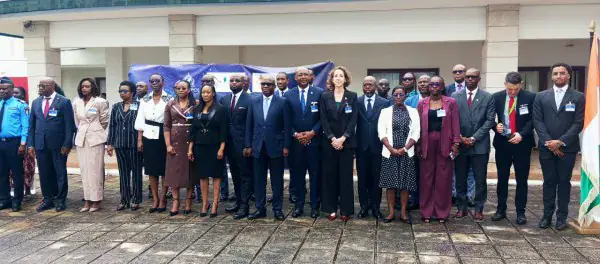
The Côte d'Ivoire government is bolstering its fight against financial crime, corruption, and money laundering with the help of Interpol and the German Development Cooperation (GIZ). A five-day advanced training workshop began on October 26, 2026, in Abidjan-Cocody, focusing on financial investigations, asset recovery, and anti-corruption efforts. The event, co-organized by Interpol's Centre for Financial and Economic Crime and the GIZ office in Abidjan, aims to equip Ivoirian authorities with specialized skills to tackle financial crimes.
The workshop, set to conclude on October 30, 2026, is a follow-up to an intermediate training session held in June 2026. Its primary objective is to enable Côte d'Ivoire to establish a national team of Interpol-certified trainers, capable of transmitting knowledge and reinforcing the capacities of competent services. Daoud Traoré, representative of Interpol's regional office for West Africa, emphasized the significance of this initiative, highlighting the need for a robust response to financial crimes, which pose a substantial threat to economic stability and development.
Financial crimes have severe consequences for African economies, with estimated annual losses of around $8.6 billion due to illicit financial flows. Célestin Ankamtsene, GIZ's project manager for Good Governance, stressed that these flows deprive the continent of considerable resources, while the amounts recovered are often meager. He underscored the importance of strengthening the capacities of institutions responsible for detecting financial crimes, conducting investigations, and recovering illicit assets.
Côte d'Ivoire has made progress in consolidating its anti-financial crime framework, particularly through the reinforcement of its penal chain and cooperation with international partners. An evaluation conducted in 2023 within the framework of the country's anti-money laundering and terrorist financing system acknowledged these advances, while emphasizing the need for continued efforts to enhance the effectiveness of existing mechanisms.
The current workshop brings together 35 participants from various components of Côte d'Ivoire's penal chain, including magistrates, judicial police officers, investigators, and technical experts. Over five days, they will receive training from specialized experts, including criminal intelligence officers from Interpol's Centre for Financial and Economic Crime. The goal is to equip these professionals with in-depth knowledge and operational tools to address financial crimes effectively.
A key aspect of this initiative is its strategic objective: to enable Côte d'Ivoire to have its own Interpol-certified trainers in financial investigations, asset recovery, and anti-corruption. This will allow the country to develop a sustainable capacity to tackle financial crimes and share expertise within the region. The Ivoirian government is committed to fighting financial crimes, which have far-reaching consequences for the country's economic stability and development.
The collaboration between Interpol, GIZ, and Côte d'Ivoire's authorities reflects a shared determination to combat financial crimes and their associated challenges. By strengthening the capacities of national actors, this initiative aims to contribute to a more effective response to these crimes, which often have transnational implications. The outcomes of this workshop will be crucial in assessing the progress made by Côte d'Ivoire in its fight against financial crime.
Key points
- Côte d'Ivoire partners with Interpol and GIZ to enhance financial crime investigation and asset recovery capabilities.
- The goal is to establish a national team of Interpol-certified trainers to tackle financial crimes.
- Financial crimes cost African economies around $8.6 billion annually in illicit financial flows.