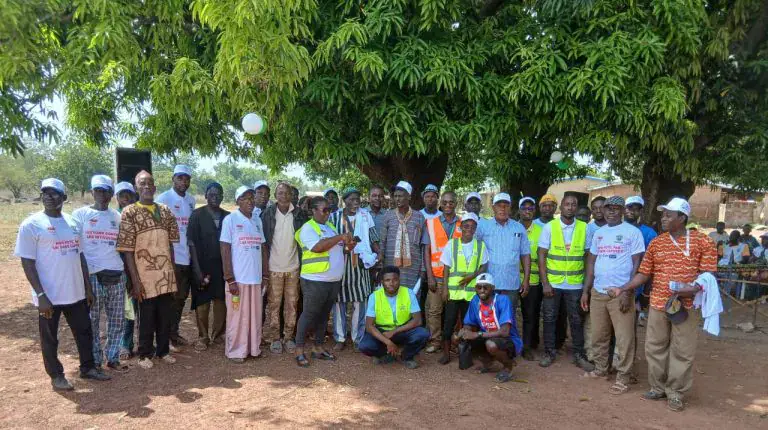
In a bid to promote social and health awareness, the populations of Kokari, a community in Côte d'Ivoire's Tengrela department, were recently sensitized to the risks associated with road safety, gender-based violence (VBG), and sexually transmitted infections (IST), including HIV/AIDS. This exercise was conducted within the framework of the Inclusive Connectivity and Rural Infrastructure Project in Côte d'Ivoire (PCR-CI).
The sensitization campaign, organized by the Interafrican NGO for the Promotion of Health and Human Rights (IPSDH), took place at the public square in Kokari. It forms part of the social accompaniment measures for the works carried out by EGETRAV under the first phase of the project in the Bagoué region, specifically lot 6. The campaign aimed to educate communities about social issues related to infrastructure works, promote responsible behaviors, and gather concerns from the populations.
Lero Paul, a community agent of IPSDH, mentioned that the PCR-CI project is co-financed by the World Bank and the Asian Infrastructure Investment Bank (AIIB). The project seeks to improve connectivity and rural infrastructure in eleven regions in the north of Côte d'Ivoire. This initiative underscores the importance of community engagement and education in ensuring the project's success and sustainability.
Assi Amoncho Judas, the conductor of EGETRAV's works, emphasized that sensitization is a crucial component of the project. It aims to prevent road accidents, combat VBG, and prevent IST/HIV-AIDS. By engaging with the community, the project stakeholders hope to mitigate potential risks and foster a culture of safety and responsibility.
The exchanges during the campaign were facilitated by Kouadio N'Guessan, representing the Tengrela social center, and Koné Paulin Martial. They discussed good road safety practices, mechanisms for preventing and managing VBG, and means of preventing IST and HIV. These discussions are expected to empower the community with the knowledge needed to make informed decisions about their health and well-being.
Ouehi Droh Jacques, representing the Papara sub-prefect, highlighted the importance of dialogue among authorities, communities, and project actors. This dialogue is crucial for preventing social risks associated with the works and promoting community participation in local development. By working together, stakeholders can ensure that the project's objectives are met while minimizing its negative impacts.
The successful execution of this sensitization campaign demonstrates the commitment of project stakeholders to the well-being of the communities they serve. By prioritizing education and community engagement, the PCR-CI project can contribute to sustainable development and improved quality of life for the people of Kokari and beyond.
Key points
- The campaign was co-financed by the World Bank and the Asian Infrastructure Investment Bank (AIIB) as part of the PCR-CI project.
- The project aims to improve connectivity and rural infrastructure in eleven regions in the north of Côte d'Ivoire.
- The sensitization campaign covered topics such as road safety, gender-based violence, and sexually transmitted infections, including HIV/AIDS.
Reporting sources
- Côte d’Ivoire-AIP/Les populations de Kokari sensibilisées aux risques sociaux et sanitaires · Agence ivoirienne de presse