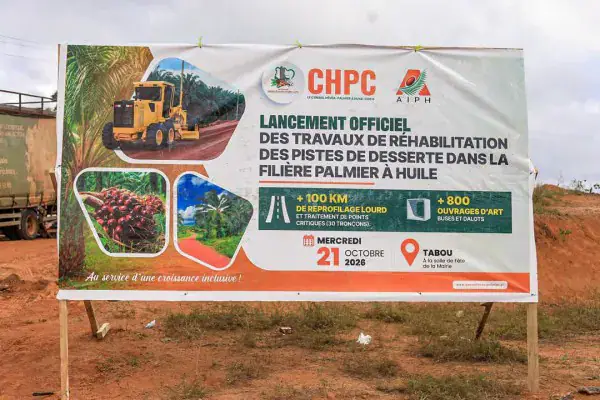
The Conseil hévéa-palmier à huile-coco (CHPC) has launched a project to rehabilitate agricultural roads in the Department of Tabou, located in the South-West region of Côte d'Ivoire. This initiative aims to facilitate the evacuation of harvests and limit revenue losses for farmers, particularly during the rainy season. The project is part of the CHPC's efforts to improve the infrastructure supporting the palm oil and coconut sectors.
The rehabilitation program plans to construct 800 infrastructure projects, including culverts and bridges, and reprofile 100 km of roads across all palm oil production areas in 2026. Specifically, in the San Pedro and Gboklê zones, the project involves reprofiling 52 km of roads and building 336 crossing structures. These interventions are designed to improve the accessibility and condition of agricultural roads, thereby enhancing the efficiency of harvest transportation.
In the Tabou department, the project includes the installation of 217 culverts of various sizes, the construction of seven bridges, and the treatment of critical points on several routes. These works are part of the interim program for the development of palm oil and coconut sectors, launched on July 31 in Grand-Béréby by the Minister of Agriculture, Rural Development, and Food Production, Bruno Nabagné Koné.
The program aims to strengthen the competitiveness and sustainability of the palm oil and coconut sectors in Côte d'Ivoire. By improving agricultural infrastructure, the CHPC seeks to increase farmers' incomes, reduce production costs, and enhance the overall efficiency of the sector. The project is expected to have a positive impact on the livelihoods of farmers and the local economy.
The CHPC's initiative is a significant step towards addressing the infrastructure challenges faced by farmers in the region. The project's focus on road rehabilitation and infrastructure development is expected to improve the accessibility of rural areas, reduce transportation costs, and enhance the overall productivity of the palm oil and coconut sectors.
The launch of this project demonstrates the commitment of the CHPC and the Ivoirian government to supporting the development of the agricultural sector. By investing in infrastructure, the government aims to create a more favorable business environment for farmers and promote sustainable agricultural practices.
The project's success is expected to have a positive impact on the Ivoirian economy, particularly in the rural areas where the palm oil and coconut sectors are a significant source of employment and income. The CHPC's initiative is a key component of the government's efforts to promote economic growth, reduce poverty, and improve living standards in rural areas.
Key points
- The CHPC's project aims to construct 800 infrastructure projects and reprofile 100 km of roads in 2026.
- The project focuses on improving agricultural infrastructure to facilitate harvest evacuation and reduce revenue losses for farmers.
- The initiative is part of the interim program for the development of palm oil and coconut sectors launched by the Minister of Agriculture.