Côte d'Ivoire's Minister of State for Public Service and Administrative Modernization, Anne Désirée Ouloto-Lamizana, announced on September 30, 2026, in Abidjan, that the government is taking steps to consolidate gains and prepare for a new stage of social dialogue. This move comes as the current social truce, which expires in 2027, approaches its end. The minister emphasized that the post-2027 period should not be prepared in 2027 but rather constructed now through concertation with trade unions.
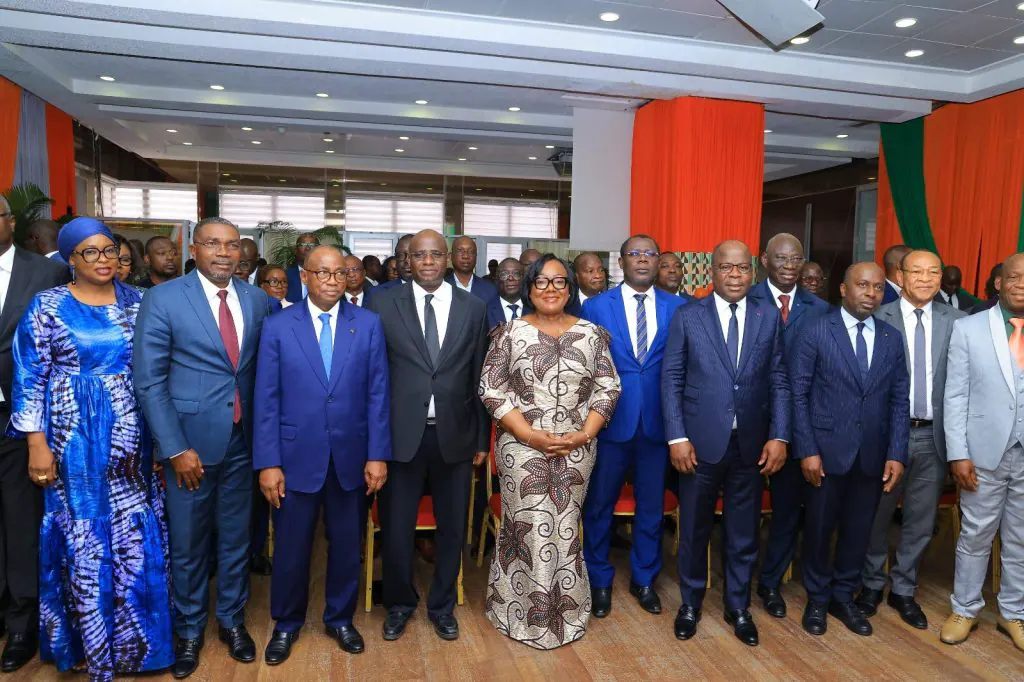
The minister made these remarks during the 2026-2027 social dialogue launch in the public service, attended by several ministers, including N'Guessan Koffi, Minister of National Education, Literacy, and Technical Education, Pierre Dimba, Minister of Health, Public Hygiene, and Universal Health Coverage, and Jean-Louis Moulot, Minister Delegate for Technical Education. Ouloto-Lamizana stressed the need to evaluate fulfilled commitments, identify areas for improvement, and examine ongoing dossiers while listening to diverse trade union organizations.
To achieve these objectives, Ouloto-Lamizana announced several meetings, including the October 15, 2026, public service advisory committee meeting, the resumption of sectoral social dialogue committee work in October, and a public service social dialogue committee meeting in November. These gatherings aim to provide platforms for dialogue, mutual listening, anticipation, and solution-seeking, aligning with the spirit of the social truce.
The minister stated that the G8, comprising eight signatory trade union organizations of the second social truce, has elaborated a chronogram of activities validated without reserve. This chronogram will serve as a common roadmap to implement social truce commitments on the ground. Ouloto-Lamizana urged all parties to honor this roadmap with consistency, responsibility, and trust.
Addressing workers' concerns about bonuses, salaries, and financially impactful issues, Ouloto-Lamizana disclosed that a study commissioned by the Ivoirian Center for Economic and Social Research (CIRES) has been completed, with findings transmitted to competent authorities. She clarified that this expertise aids decision-making but does not constitute a government decision in itself.
Soro Mamadou, spokesperson for the G8, expressed the group's preference for continued social dialogue and negotiation over confrontation. He welcomed the minister's commitment to anchoring social dialogue in Côte d'Ivoire's governance and viewed the meeting as a preliminary discussion toward significant negotiations.
The government's initiative aims to ensure a smooth transition and maintain social peace. Key stakeholders will continue to engage in dialogue to address pending issues and chart a new course for social relations in Côte d'Ivoire.
Key points
- The government of Côte d'Ivoire is strengthening consultation frameworks with trade unions to prepare for the post-2027 social truce.
- A chronogram of activities has been validated to serve as a roadmap for implementing social truce commitments.
- The government has completed a study on workers' concerns, which will aid decision-making on bonuses, salaries, and other financially impactful issues.