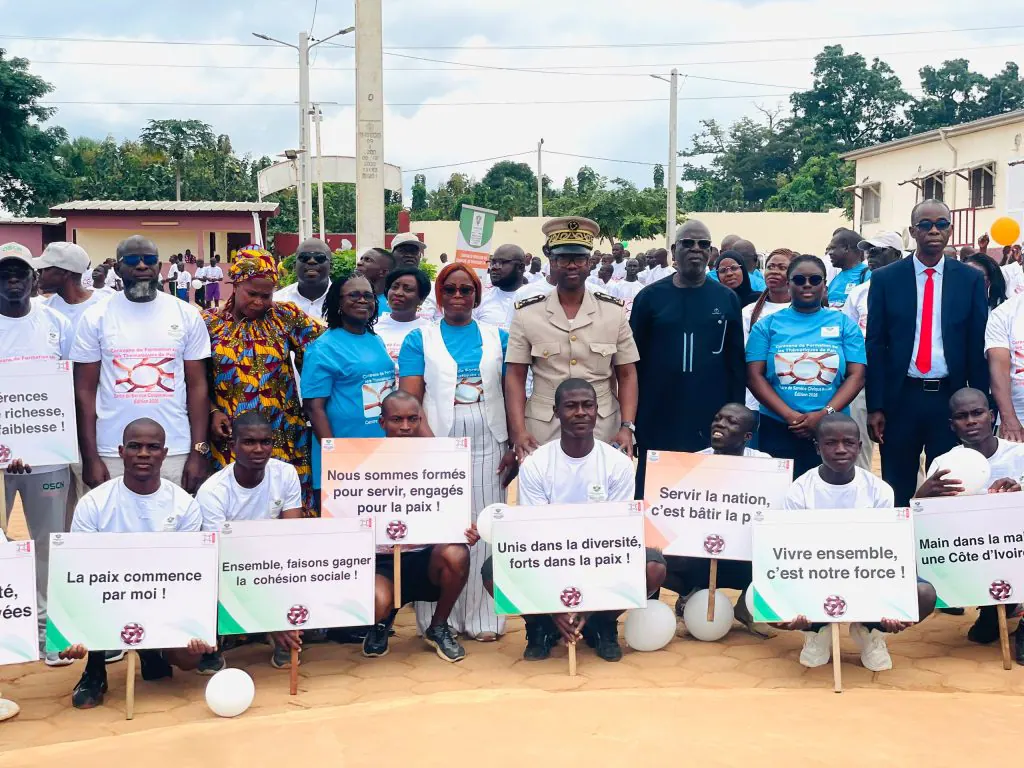
The National Social Cohesion Program (PNCS) in Côte d'Ivoire has conducted a training program for residents of Bouaké 1 and 2 Civic Service Centers from September 29 to October 3, 2026. This initiative, jointly organized by the Ministry of National Cohesion, Solidarity, and Poverty Fight and the Ministry of Youth, aimed to equip young people with skills to prevent conflicts and promote peace. The program brought together trainers, regional authorities, and volunteer trainees to focus on values of coexistence and responsible citizenship.
The training sessions took place at Bouaké 2 Civic Service Center from September 29 to October 1 and at Bouaké 1 from October 1 to 3, 2026. At the opening ceremony, representatives of the centers' directors praised the initiative, highlighting its potential to strengthen the moral rearmament of residents and consolidate their role in social transformation and civic reintegration.
Mangoua Laurette épouse Soro, Director of PNCS, encouraged volunteer trainees to fully embrace the modules provided, emphasizing the importance of youth in promoting peace and stability. Citing the principles of UN Security Council Resolution 2250 on Youth, Peace, and Security, she noted that young people are essential for change and peace consolidation.
Kouadio Marie épouse Koné, Director-General of National Cohesion, representing the Minister, underscored the strategic importance of the agreement between her ministry and the Ministry of Youth. She stressed the need to provide young people with concrete dialogue and mediation tools to foster a culture of peace from an early stage.
Vanié Bi, Secretary-General of the Prefecture, representing the Prefect of Gbêkê Region, congratulated the government and stakeholders on this initiative, emphasizing its significance in promoting social stability and peace in Bouaké. He encouraged residents to demonstrate discipline and active listening, highlighting their crucial role in maintaining social cohesion.
The five-day training program combined theoretical modules on conflict prevention and management, community mediation techniques, family dispute resolution, non-violent communication, and reproductive health. Evening sessions featured experiential learning through role-playing, mediation simulations, thematic quizzes, and artistic creations such as slam, storytelling, and theater.
The program concluded with a festive atmosphere, marked by sports events, a civic parade, prize-giving to outstanding teams, and the symbolic release of the "Ballon de la Paix," symbolizing the renewed commitment of these young people to promoting national cohesion in the Gbêkê region.
Key points
- The PNCS aims to empower young people as peace ambassadors and conflict prevention actors in Côte d'Ivoire.