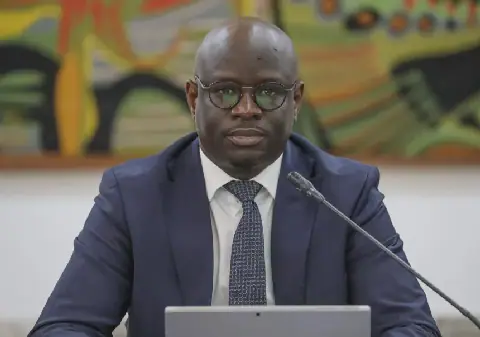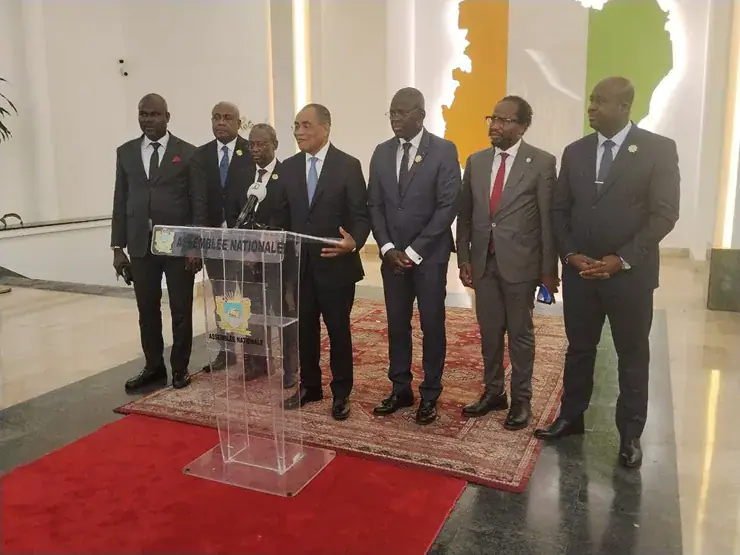
The Commission des affaires économiques et financières (CAEF) of Côte d'Ivoire's Assemblée nationale has unanimously adopted the 2027 budget, totaling 18,466.1 billion FCFA. This represents a 6.4% increase from the 2026 budget. The project was presented by Minister of Economy, Finances, and Budget, Adama Coulibaly. The budget aims to fund the government's economic and social priorities in line with the Plan national de développement (PND) 2026-2030.
The proposed budget focuses on strengthening domestic revenue mobilization, rationalizing operating expenses, controlling public debt, and increasing strategic investments. These measures are part of the government's efforts to address poverty and navigate an uncertain international context. Factors such as geopolitical tensions, conflicts, and climate change effects impact the country's economic outlook. Additionally, the volatility of international commodity markets, particularly the decline in cocoa prices, poses challenges.
The government's macroeconomic forecasts predict 6.6% growth in 2027, up from 6.2% in 2026. The budget deficit is expected to decrease to 3.5% of the gross domestic product (GDP), compared to 3.8% in 2026. The goal is to meet the community standard of a maximum 3% deficit by 2028. Budget revenues are estimated at 9,385.4 billion FCFA, comprising 8,814.4 billion FCFA in tax revenues and 339.4 billion FCFA in non-tax revenues.
The budget outlines 7,399.1 billion FCFA in treasury resources, primarily from short, medium, and long-term loans. On the expenditure side, 4,963.7 billion FCFA is allocated for public investments, 3,130 billion FCFA for personnel expenses, and 1,893.7 billion FCFA for public debt financial charges. The 2027 budget is structured into 27 appropriations and 160 programs distributed among institutions and ministries.
The CAEF's examination of the budget focused on the general conditions of financial balance and the provisions related to institutional and ministerial expenditures. Following the review of articles and discussions with the minister, the commission members unanimously adopted the 2027 budget bill. This adoption marks a step in the budgetary process, preceding the plenary session of the Assemblée nationale.
The budget's adoption in commission reflects the government's efforts to ensure a balanced and growth-oriented budget. The planned increase in public investments and focus on poverty reduction are expected to drive economic growth. However, the international context and commodity market volatility will require careful management to achieve the projected growth and deficit targets.
The 2027 budget aims to support Côte d'Ivoire's economic and social development goals. Its implementation will be crucial in achieving the objectives outlined in the PND 2026-2030. The government's commitment to strengthening revenue mobilization and controlling public debt will be essential in maintaining macroeconomic stability.
Key points
- The 2027 budget for Côte d'Ivoire is set at 18,466.1 billion FCFA, representing a 6.4% increase from 2026.
- The budget aims to support economic growth and poverty reduction efforts.
- The government targets a 6.6% growth rate and a 3.5% budget deficit in 2027.
Reporting sources
- Côte d’Ivoire-AIP/ Les députés adoptent en commission un budget de 18 466 milliards FCFA pour 2027 · Agence ivoirienne de presse