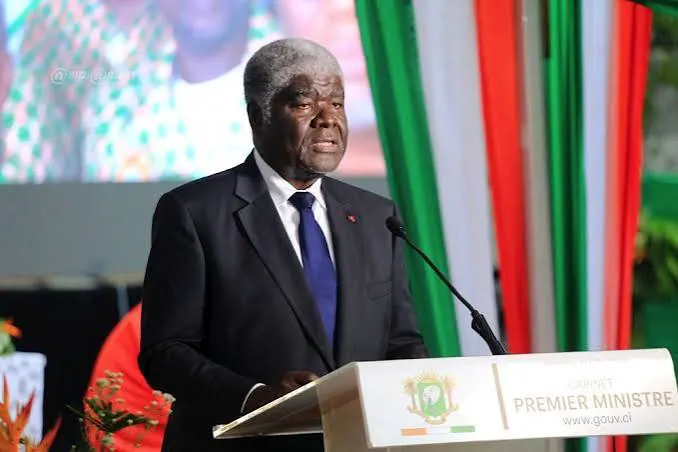
The Ivoirian government is pushing for electoral reform, with a focus on replacing the Independent Electoral Commission (CEI), which was dissolved on May 6, 2026, after 25 years of existence. The government aims to restore trust in the electoral process by separating the organization, counting, and supervision of elections. Prime Minister Robert Beugré Mambé presented the government's plan to political parties and civil society groups on June 22.
The government's proposal involves creating a new body with three main functions: organizing elections, counting votes, and supervising the process. The goal is to prevent one institution from controlling the entire process. The government also wants to preserve the expertise and technical capabilities of the CEI, including its experience in organizing elections and managing electoral lists. Technology will play a key role in the new system, including voter identification, geolocation of polling stations, and result transmission.
However, opposition parties and civil society groups argue that technical reforms are not enough to restore trust. They advocate for a truly independent electoral body, free from direct representation by political parties and government officials. Simone Ehivet Gbagbo and several civil society organizations initially proposed a High Council for Elections (HCE), composed of independent personalities from various sectors.
The HCE proposal has evolved, with a new architecture of 13 members, designed to be independent from political parties and the executive. Other proposals have emerged, including the Coalition for a Peaceful Alternation in Côte d'Ivoire (CAP-CI), which advocates for a National Independent Electoral Commission, and the Alliance for Côte d'Ivoire (ADCI), which proposes a National Elections and Statistics Agency (ANES).
On October 5, several opposition parties, including the PPA-CI of Laurent Gbagbo, CAP-CI of Pascal Affi N'Guessan, and ADCI of Assalé Tiémoko, submitted a joint proposal to the Minister of Interior and Security, Vagondo Diomandé. The proposal combines elements from the different approaches, including a High Council for Elections and a Commission for observation and surveillance.
The joint proposal emphasizes the need for an independent, neutral, and impartial electoral body, with experts recruited based on merit. The body would be responsible for organizing elections, while a separate commission would oversee and monitor the process. Pascal Affi N'Guessan stressed that "trust does not exclude control" and that the opposition wants to ensure the electoral body's independence.
However, not all parties agree on the joint proposal. The PDCI-RDA, a major opposition party, has chosen to maintain its own approach, submitting its proposals to the Minister of Interior and Security on September 28. The party's spokesperson, Brédoumy Soumaïla, stated that Ivoirians expect more than just a change of name and that the party's proposal aims to address the root causes of the electoral crisis.
Key points
- The Ivoirian government and opposition parties are working on reforming the electoral system, with a focus on creating an independent and impartial electoral body.
- The opposition has proposed a joint architecture for the new electoral body, combining elements from different approaches.
- The PDCI-RDA has chosen to maintain its own approach, submitting its proposals to the Minister of Interior and Security.