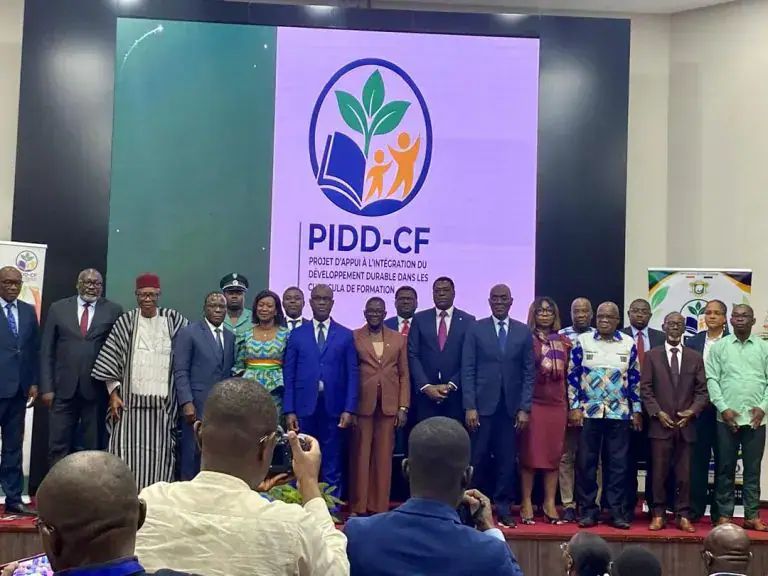
The Ivoirian government has initiated a project to incorporate sustainable development into school curricula, aiming to educate students on ecological transition and climate resilience. The project, launched on November 25, 2026, in Abidjan, is titled the Project to Support the Integration of Sustainable Development into Training Curricula (PIDD-CF). It has a budget of 373 million FCFA over three years. The project's goal is to make schools a lever for eco-citizenship and climate resilience.
The project was launched by Parfait Kouadio, the cabinet director of the Minister of Environment and Ecological Transition. He emphasized that young people make up the majority of Côte d'Ivoire's population and that ecological transition cannot be decreed but must be learned and built within classrooms, universities, training centers, and CAFOP. Kouadio also highlighted that Côte d'Ivoire is already experiencing the effects of climate change and natural resource degradation, including coastal erosion, flooding, and pressure on ecosystems.
The project aims to address the weak integration of Education for Sustainable Development (ESD) into the current education system. This weakness is characterized by insufficient pedagogical content, a lack of adapted resources, and inadequate training for teachers. The project will focus on translating the 2030 Education Agenda at the national level. It is being implemented by the Ministry of Environment and Ecological Transition through the Directorate for the Promotion and Education for Sustainable Development (DPEDD), in collaboration with the Ministry of National Education.
The pilot phase of the project will cover 50 establishments in five cities and regions: Abidjan, Yamoussoukro, Abengourou, Daloa, and Korhogo. It will directly impact over 10,000 students and more than 500 teachers, pedagogical supervisors, and education system actors. The initiative aligns with the implementation of several Sustainable Development Goals (SDGs), specifically SDG 4, 12, 13, and 15. These goals focus on quality education, responsible consumption and production, climate action, and life on land.
The PIDD-CF project is structured around three main components. The first component involves the design and development of educational programs, accounting for approximately 36% of the project. The second component focuses on mobilizing and strengthening the capacities of stakeholders, representing about 22%. The third component is dedicated to project management and monitoring-evaluation, covering around 42%. The project is fully funded by the Ivoirian State without any external borrowing.
According to Yao Christine, the project coordinator, the initiative is open to technical and financial support from partners, local authorities, the private sector, and civil society. The project's implementation is expected to enhance the integration of sustainable development into the education system, thereby contributing to the country's ecological transition and climate resilience efforts. This approach aligns with global trends and forecasts, which indicate that climate change could displace over 216 million people within their countries by 2050.
The launch of the PIDD-CF project reflects Côte d'Ivoire's commitment to addressing the challenges of climate change and sustainable development through education. By integrating sustainable development into school curricula, the government aims to equip future generations with the knowledge and skills necessary to build a more resilient and environmentally conscious society. The project's success will depend on effective collaboration among stakeholders and the continued support of partners.
Key points
- The project has a budget of 373 million FCFA over three years to integrate sustainable development into school curricula.
- The pilot phase will cover 50 establishments and impact over 10,000 students and 500 teachers.
- The project aligns with several Sustainable Development Goals (SDGs), including SDG 4, 12, 13, and 15.
Reporting sources
- AIP/ Le PIDD-CF lancé à Abidjan pour ancrer la transition écologique dans les écoles ivoiriennes · Agence ivoirienne de presse