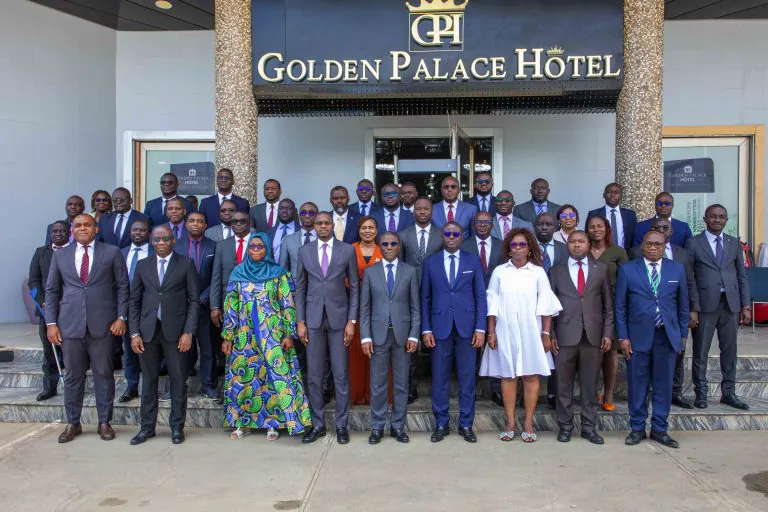
Experts from Côte d'Ivoire's public and parastatal administrations gathered in Grand-Bassam from September 21 to 25, 2026, to harmonize economic and financial data for the country's 2026-2031 projections. The five-day workshop was opened by Beugré Amos, Deputy Director-General of the Treasury and Public Accounting. The meeting brought together actors responsible for macroeconomic forecasting and sectoral statistics.
The workshop aimed to review the implementation of the 2023-2026 Economic and Financial Program (PEF), examine its main results, and identify lessons to be considered in preparing future economic prospects. Participants worked to ensure coherence among different macroeconomic accounts and revise the 2026-2031 macroeconomic framework. This revision was based on new projection hypotheses.
At the workshop's closing, Ahoussi Arthur Augustin Pascal, Director-General of the Treasury and Public Accounting, representing the Minister of Economy, Finance, and Budget's cabinet director, highlighted the favorable prospects for Côte d'Ivoire's economy. He stated that the country is showing good economic and financial health, citing results from the workshop.
According to projections presented, Côte d'Ivoire's real GDP growth is expected to reach 6.2% in 2026, compared to 4.3% on average in Sub-Saharan Africa. Inflation is projected at 2.2%, below the 3% community norm. The budget deficit is expected to be 3.8% of GDP, while the current account balance is projected at -1.5% of GDP.
These prospects are expected to be supported by ongoing reforms under the 2023-2026 PEF, particularly in budget consolidation. Despite global economic uncertainties, the implementation of the 2026-2030 National Development Plan (PND) will contribute to sustaining this dynamic. The plan involves continued public investments in priority and social infrastructure, poverty reduction, local transformation of raw materials, and improved producer incomes.
Ahoussi noted that the revised macroeconomic framework is a strategic orientation tool for the government's economic and budgetary policy decisions. He announced that the results and recommendations from the workshop would be transmitted to his hierarchy. This aims to prepare for upcoming consultations with the International Monetary Fund (IMF).
The workshop was coordinated by Touré Vakaramoko, Director of Statistical Coordination. The meeting's outcomes will inform Côte d'Ivoire's future economic planning and policy decisions. The country's economic prospects appear favorable, driven by ongoing reforms and development plans.
Key points
- Côte d'Ivoire's real GDP growth is expected to reach 6.2% in 2026.
- The country's inflation rate is projected at 2.2%, below the community norm.
- The revised macroeconomic framework will guide the government's economic and budgetary policy decisions.