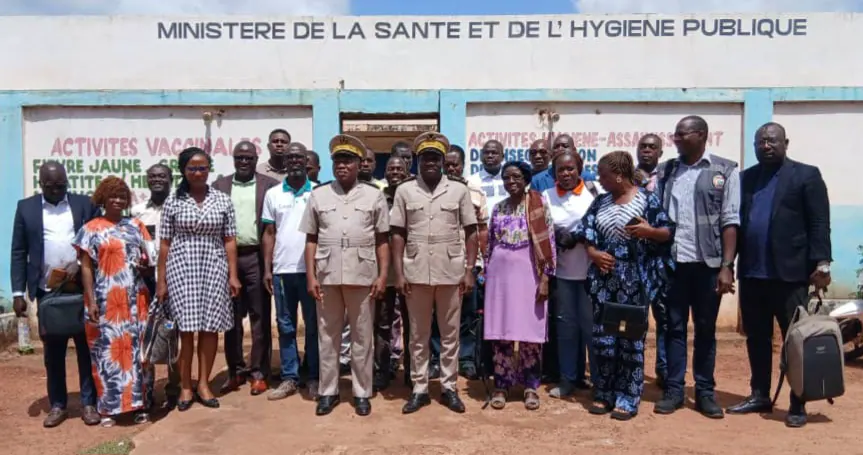
The Committee for coordination and monitoring of World Bank-funded projects in Côte d'Ivoire's Tengrela department convened for its third session of 2026 on September 29. The meeting followed a site visit on September 28, allowing committee members to assess the progress of ongoing projects and identify areas requiring improvement. The visit included the Nigouni-Zanasso-Kolonza axis, where reprofiling work is underway as part of the Inclusive Connectivity and Rural Infrastructure Project in Côte d'Ivoire (PCR-CI).
During the site visit, the delegation observed several shortcomings, particularly on the Nigouni-Zanasso-Kolonza axis. Tengrela department prefect, Mme Gnaléga Ruth Anne-Marie Brou, addressed recommendations to the construction company. These included rehabilitating defective structures, replacing degraded culverts with dalots where necessary, and installing culverts at critical points. The control mission was also urged to enhance its on-site presence to ensure better monitoring of work execution and adherence to technical specifications.
The delegation then visited the Tengrela modern high school, where they evaluated the progress of the perimeter fence construction under the Sustainable and Inclusive Development of Secondary Cities Project (PDDIVS). The project has achieved a 70% execution rate. During the committee session, coordinators from various projects presented updates on their activities. While overall implementation was deemed satisfactory, delays persist in the execution of certain sub-projects.
Under the PCR-CI, the committee noted the absence of deviations on certain work sections. For the Social Cohesion Project for the Northern Regions of the Gulf of Guinea (COSO), shortcomings were observed in collaboration with local actors for establishing village committees to manage structures under the authority of sub-prefects. The committee also evaluated the Water Security and Sanitation Improvement Project (PASEA), where the concerns included the exclusion of fishermen from the compensation process for individuals affected by the rehabilitation of the Tengrela dam.
The committee's session also addressed specific challenges in project implementation. For the PCR-CI, concerns were raised about the absence of deviations on certain work sections, which could impact the project's overall progress. In the COSO project, the committee emphasized the need for improved collaboration with local actors to ensure effective management of village committees.
The committee's recommendations aim to address the identified challenges and improve project execution. The prefect urged project coordinators and construction companies to implement the formulated recommendations. The committee's efforts focus on ensuring that World Bank-funded projects in Tengrela are completed efficiently and effectively, ultimately benefiting the local population.
The committee's session concluded with an appreciation for the members' involvement and an appeal to stakeholders to implement the recommendations. By addressing the identified challenges, the committee aims to enhance the overall impact of World Bank-funded projects in Tengrela, contributing to the region's development and growth.
Key points
- The committee identified delays and shortcomings in the implementation of World Bank-funded projects in Tengrela, Côte d'Ivoire.
- Recommendations were made to address the challenges, including rehabilitating defective structures and improving collaboration with local actors.
- The committee emphasized the need for improved monitoring and execution of project activities to ensure efficient completion.