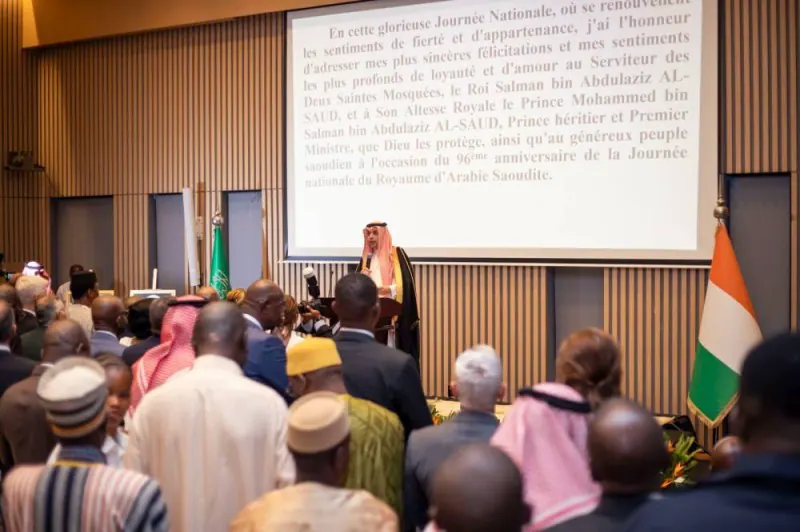
The cooperation between Côte d'Ivoire and Saudi Arabia was at the center of a ceremony held on September 24, 2026, at the Noom hotel in Abidjan-Plateau. The meeting, marking the 96th National Day of the Kingdom, brought together several high-ranking Ivorian officials, members of the diplomatic corps, representatives of religious leaders, and media professionals. The event was attended by notable figures, including the President of the Parliament, Patrick Achi, the Minister of State Heritage and Public Enterprises, Mariétou Koné, and the Minister of Communication, Amadou Coulibaly.
The Saudi Ambassador to Côte d'Ivoire, Saad Bakheat Alqathami, highlighted the progress made by his country and the evolution of relations between Riyadh and Yamoussoukro. The Saudi National Day, celebrated on September 23, commemorates the unification of the Kingdom under the leadership of King Abdulaziz bin Abdulrahman Al Saud. In 2026, it marked its 96th edition. The ambassador emphasized the transformations undertaken by the Kingdom, including the development of infrastructure, universities, and research centers, as well as the diversification of the economy.
The transformations in Saudi Arabia are part of the Vision 2030, which prioritizes investment, industry, technology, tourism, renewable energy, and knowledge economy. The ambassador stressed that this modernization must be accompanied by the preservation of the Kingdom's identity and religious heritage, particularly around Mecca and Medina. Côte d'Ivoire occupies a special place in Saudi Arabia's foreign policy, with diplomatic relations established in 1985 and gradually expanded to several sectors, including development, humanitarian action, health, investment, security, education, and political exchanges.
A new stage in the cooperation between the two countries was reached in 2021 with the signing of a framework agreement in Abidjan, aimed at strengthening exchanges in several areas, including economy, commerce, investment, education, science, culture, media, tourism, youth, and sports. The Saudi Fund for Development is also an instrument of this partnership, having supported several Ivorian projects. The two countries now seek to expand this collaboration to other sectors, including agriculture, renewable energy, housing, and infrastructure.
Humanitarian action and religious cooperation are also essential components of the partnership between Côte d'Ivoire and Saudi Arabia. The King Salman Center for Relief and Humanitarian Aid plans to launch a new edition of the "Noor Saudi Arabia" ophthalmological initiative in Abidjan, which will provide medical examinations to over 5,000 people and cataract surgeries to around 800 individuals. The "Route to Mecca" initiative is another example of this cooperation, allowing pilgrims to complete some of the formalities related to the Hajj before their departure.
The Saudi Ambassador mentioned new prospects for cooperation with Côte d'Ivoire, particularly around the National Development Plan (PND) 2026-2030. Investment, agriculture, food security, energy, infrastructure, education, training, commerce, and industry were cited as areas that could host new partnerships. The ambassador praised Côte d'Ivoire's economic performance and reaffirmed Riyadh's willingness to explore new investment and cooperation opportunities.
The 96th National Day of the Kingdom of Saudi Arabia in Abidjan highlighted the achievements of a cooperation that has been ongoing for several decades. The event paved the way for new discussions around sectors that will bring the two economies and peoples closer together. The Saudi Ambassador also recalled his country's positions on several regional crises, including the Israeli-Palestinian conflict and the importance of dialogue and respect for international law.
Key points
- Saudi Arabia announces new investment opportunities in Côte d'Ivoire
- The two countries seek to expand cooperation to new sectors, including agriculture, renewable energy, and infrastructure
- The partnership between Côte d'Ivoire and Saudi Arabia includes humanitarian action, religious cooperation, and economic development.