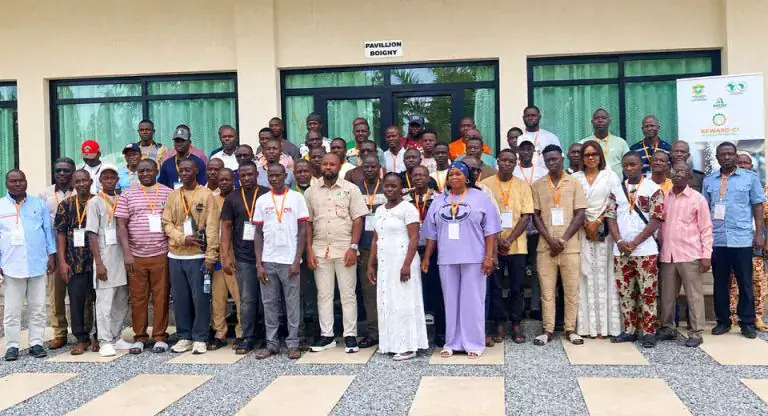
The Agence pour le développement de la filière riz (ADERIZ) has launched a project to improve the quality and competitiveness of locally produced rice in Côte d'Ivoire. The project, part of the Regional Project for the Development of Resilient Rice Value Chains in West Africa (REWARD-CI), kicked off with a four-day training workshop in Yamoussoukro for rice millers. The training aims to enhance the skills of millers to improve the quality of locally produced rice and make it more competitive against imported rice.
The training workshop brings together managers and owners of mini-rice mills with a capacity of one to two tons per hour, which are the primary suppliers of the local market. The goal is to equip them with the knowledge to optimize their equipment and production processes to produce higher-quality rice that meets market demands. According to Brou Jérémy Kouadio, head of technical operations at REWARD-CI, the project addresses three major challenges faced by rice mills: inadequate paddy supply, poor quality of paddy received, and lack of suitable equipment.
The project also includes a diagnostic mission to each mill to identify specific needs and prepare them for compliance with environmental standards, a prerequisite for accessing bank financing. Additionally, the project plans to construct central purchasing centers and distribute 75,000 standardized packaging materials to improve the presentation and marketing of local rice. This initiative is part of the first phase of REWARD-CI, which began in June 2026 and will run until April 30, 2028.
The project will be implemented in seven to eight regions of Côte d'Ivoire, including Poro, Bélier, Gbêkê, and Nawa. Two pilot zones have been selected: the Yabra rice perimeter in Poro, covering 380 hectares, and the Sakassou area in Gbêkê. The project aims to contribute to food sovereignty in West Africa by providing consumers with high-quality rice and increasing private investment in the rice value chain.
The REWARD-CI project aligns with the National Strategy for the Development of the Rice Sector, led by the Ministry of Agriculture and Food Production. The strategy aims to make rice a competitive sector by 2030. The project will be implemented over five to six years, with the first phase focusing on preparatory activities.
The project's impact is expected to be significant, with the potential to improve the livelihoods of rice farmers and millers. By enhancing the quality and competitiveness of local rice, the project can also help reduce the country's reliance on imported rice. According to Kouadio, the project's success will depend on the active participation of rice millers and farmers.
The project's long-term goal is to make Côte d'Ivoire self-sufficient in rice production by 2030. With the right strategies and investments in place, the country can achieve this goal and become a major player in the regional rice market. The project's progress will be closely monitored, and its outcomes will be evaluated to inform future initiatives.
Key points
- The project aims to achieve rice self-sufficiency in Côte d'Ivoire by 2030.
- The project includes training for rice millers and infrastructure development.
- The project is part of a broader strategy to develop the rice sector in West Africa.