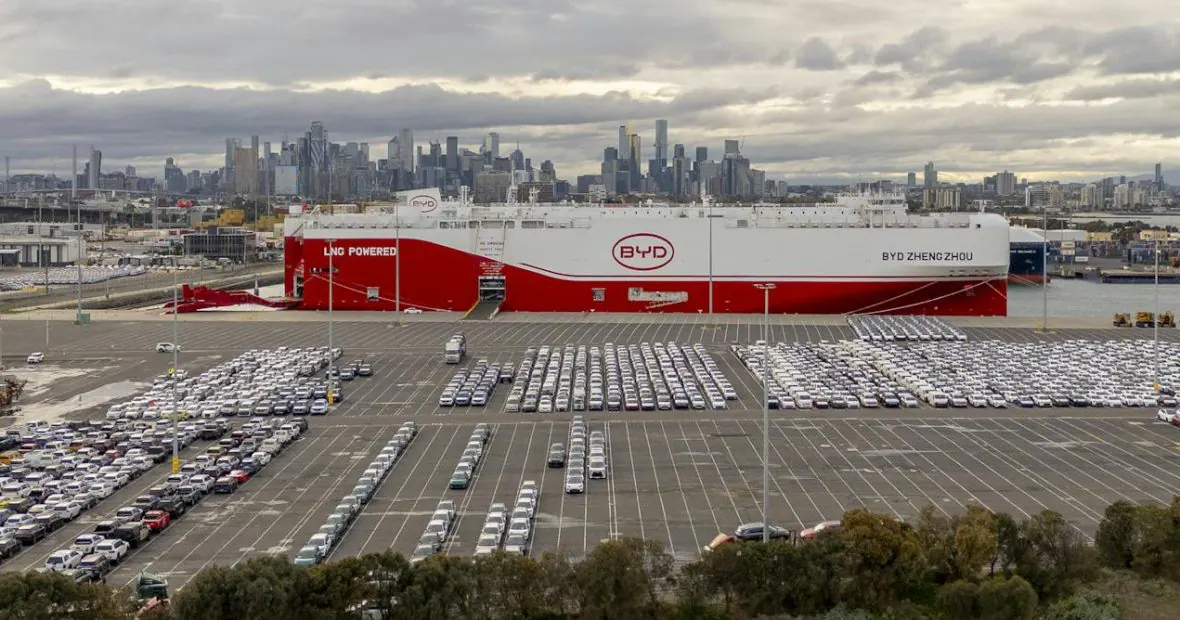
The electric vehicle market in Australia has experienced significant growth this year, driven by global oil market disruptions and fuel price uncertainty. As a result, EVs now account for 25.8% of total car sales in the first half of 2026. One brand capitalizing on this trend is Chinese carmaker BYD, which has become the country's second-highest selling car brand. BYD's rapid ascent can be attributed to four key factors, including its vertical integration, diverse product offerings, innovative battery technology, and government support.
BYD's origin story began not with cars, but batteries. Founded in 1995 by 29-year-old battery specialist Wang Chuanfu in Shenzhen, the company initially manufactured rechargeable nickel-cadmium batteries before moving into lithium-ion batteries. BYD grew quickly, becoming Motorola's first Chinese supplier of lithium-ion batteries in 2000 and listing on the Hong Kong Stock Exchange in 2002. In 2003, BYD entered the automotive industry by acquiring a struggling Chinese manufacturer.
BYD's first model, the petrol-powered F3, arrived in 2005, and the company began exploring electrification with the launch of the F3DM plug-in hybrid in 2008. That same year, US investor Warren Buffett backed the company with a $230 million investment for a 9.9% stake. Initially, Tesla CEO Elon Musk dismissed BYD as a competitor, but by 2023, he had changed his assessment, acknowledging that BYD's cars are "highly competitive."
BYD's sales figures demonstrate its rapid growth, both globally and in Australia. In 2020, the company sold around 190,000 battery or hybrid vehicles, increasing to 4.6 million in 2025. Of these 2025 sales, 2.26 million were fully electric, surpassing Tesla's 1.64 million deliveries. In Australia, BYD sold over 68,000 vehicles in the first eight months of 2026, making it the country's second-highest selling car brand.
So, what is BYD's secret sauce? The company's vertical integration plays a significant role, as it manufactures a large proportion of its cars, including batteries, electric motors, and semiconductors. This reduces its reliance on outside suppliers and gives BYD greater control over its supply chain and production costs. Additionally, BYD's diverse product offerings, including plug-in hybrids, have helped attract buyers.
BYD's innovative battery technology, specifically its Blade Battery using lithium iron phosphate chemistry, has also contributed to its success. This approach is generally cheaper than nickel-based alternatives and requires neither nickel nor cobalt. Furthermore, BYD has benefited from China's long-running support for its electric vehicle industry, including direct subsidies to manufacturers and consumer incentives.
Despite its global success, BYD has faced controversy, including cybersecurity concerns and safety issues. In Australia, a recent investigation highlighted potential security risks, while safety regulator ANCAP awarded the Shark 6 five stars but applied a penalty score for posing a greater risk to oncoming vehicles. As the global car market continues to evolve, Chinese brands like BYD are challenging the traditional dominance of Japanese, US, Korean, and European manufacturers.
Key points
- BYD's rapid ascent in Australia's car market can be attributed to its vertical integration, diverse product offerings, innovative battery technology, and government support.
- The company's sales figures demonstrate its rapid growth, both globally and in Australia, with 4.6 million vehicles sold in 2025.
- BYD's success has significant implications for the global car market, as Chinese brands challenge traditional dominance.