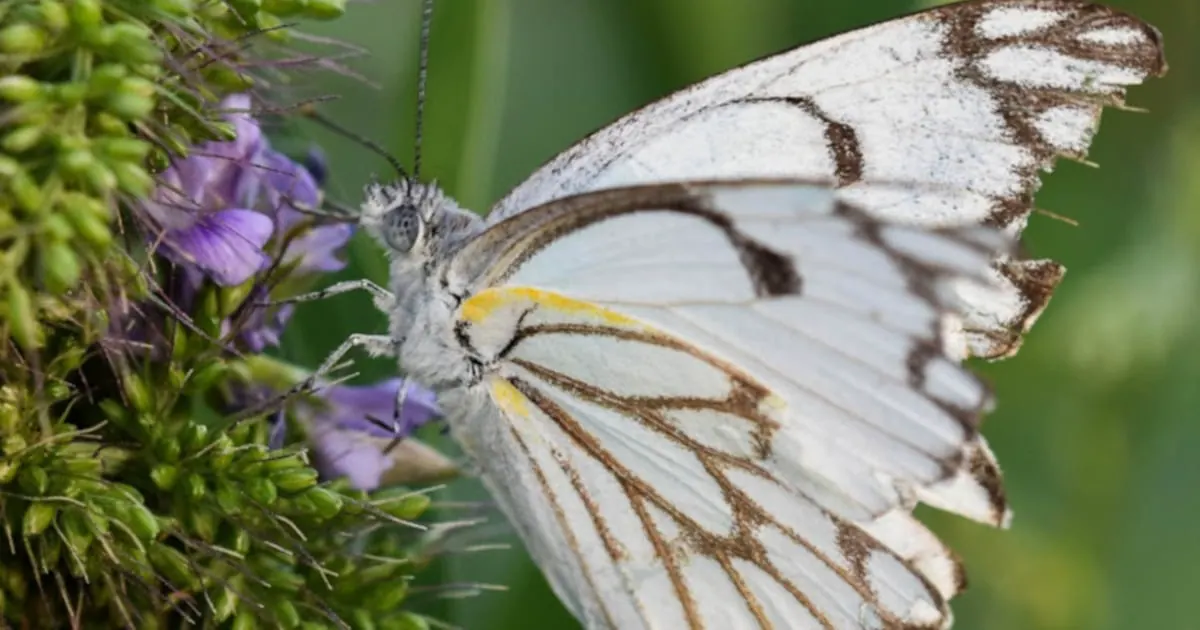
A team of researchers, led by Professor Jolyon Troscianko from the University of Exeter in England, has discovered that butterfly wing patterns can create motion illusions, making it difficult for predators to catch them. The study, published in the journal Nature, found that the patterns on butterfly wings combine with their wingbeats to create optical illusions, making it look like the butterfly is moving in a different direction to its actual course. This natural defence mechanism may be crucial in helping butterflies evade predators.
The idea that stripes and other bold markings can create "motion dazzle" has long been proposed by scientists. However, experiments involving animals such as zebras, snakes, and lizards have produced mixed evidence. The researchers overcame this limitation by combining high-speed filming of real butterflies, computer modelling, simulated evolution, and touchscreen experiments. This approach allowed them to investigate the idea that butterfly wing patterns can interfere with the circuits that detect motion.
The study found that stripes are particularly effective at interfering with motion detection. The researchers cited the "barber pole illusion" as an example, where stripes moving sideways can appear to be moving up or down instead. The patterns also appear to increase uncertainty about a butterfly's position during an attack. According to Troscianko, this "confusion" effect would be almost impossible to overcome without evolving a fundamentally different visual system.
Not all butterflies appear to use this strategy, however. The researchers found that the least motion-confusing butterflies are typically brown or red, suggesting that some species may rely more on camouflage or warning colours. These colours may signal to predators that the insect is toxic, poisonous, or has a bad taste. The study's findings suggest that motion confusion may have been pivotal to the success of butterflies as a group.
To test whether the effects could influence attacks, the researchers recruited 100 human volunteers and carried out 3,000 virtual butterfly-catching experiments. Participants watched videos and attempted to catch butterflies by tapping a screen. The results showed that butterflies that were predicted to produce stronger visual confusion caused people to aim farther behind them.
The researchers hope that their findings can translate between different species, as the neural circuits involved in motion vision are quite fundamental in vertebrates. However, they note that motion confusion may not fool all predators equally. The team plans to explore the potential applications of their motion-vision tools, including improving road safety and reducing discomfort and stress in the built environment.
The study's findings have significant implications beyond biology. The team's motion-vision tools could be used to develop patterning that protects personnel, vehicles, drones, or robots in motion when being targeted visually. Troscianko expressed excitement about exploring the potential applications of their models, particularly in improving road safety and reducing harm or danger caused by flashing, moving, and striped objects.
Key points
- Butterfly wing patterns create optical illusions that make it harder for predators to judge their speed and direction during flight.
- The patterns on butterfly wings combine with their wingbeats to create motion illusions.
- The study's findings have potential applications in improving road safety and reducing discomfort and stress in the built environment.