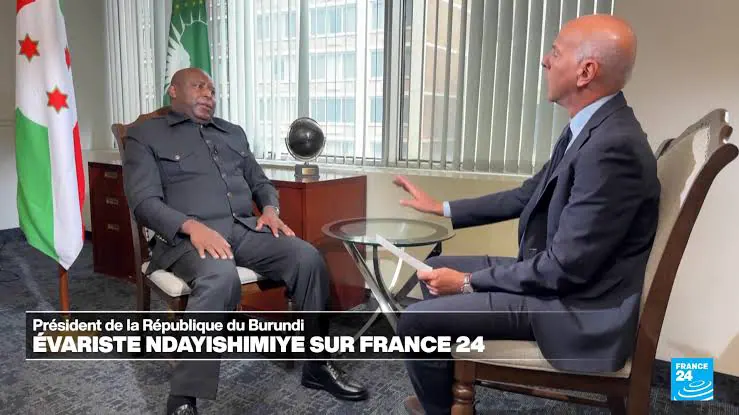
Burundian President Évariste Ndayishimiye recently appeared on France 24, portraying himself as a victim of Rwandan aggression. However, this portrayal has been disputed by critics who argue that Ndayishimiye's claims are misleading. According to Mupenzi David Rutaganda, Ndayishimiye's goal is to bury the context of his own aggression, rewrite the timeline of the conflict, and convince the world that Rwanda is the threat while Burundi is merely collateral damage.
To understand Ndayishimiye's current stance, it is essential to recall his previous statements. In January 2024, Ndayishimiye, as African Union Champion for Youth, Peace and Security, presented himself as a liberator in Kinshasa. He told a crowd of Congolese youth that Rwandan youth were "prisoners" in their own country and pledged his support for Rwandan youth seeking to topple the government in Kigali. This speech was delivered weeks before Félix Tshisekedi promised to seek parliamentary approval for an invasion of Rwanda.
At the time of Ndayishimiye's speech, Burundian troops were already deployed in North Kivu, alongside the Congolese army, SADC troops, European mercenaries, the FDLR, and Wazalendo militias. The presence of Burundian troops in the region contradicts Ndayishimiye's current claims that his concerns about Rwanda are defensive. Instead, it appears that Ndayishimiye was positioning himself as a co-belligerent in a war aimed at regime change in Kigali.
Ndayishimiye's claims about the FDLR's presence in the region have also been disputed. He acknowledges the group's presence in Congolese territory but insists that Burundian forces operate in a zone free of FDLR presence. However, the United Nations has documented persistent collaboration between FARDC units and the FDLR, including co-location and joint operations. Burundian forces are embedded within the FARDC-led coalition, making it unlikely that they operate in a hermetically sealed zone.
Ndayishimiye also wants to convince the world that Rwanda has harbored a long-standing plan to attack Burundi. However, this narrative collapses under the weight of recent history. Burundi and Rwanda had normalized relations, and borders were reopened in 2022. Ndayishimiye himself benefited from Rwandan intelligence cooperation in surviving a coup attempt by his own prime minister, Alain Guillaume Bunyoni.
The interview on France 24 has been seen as an influence operation, with Ndayishimiye attempting to shift the blame to Rwanda. His vision for peace, which involves the lifting of Rwanda's defensive measures and the cantonment of the M23, has been criticized as a demand for surrender. The M23 now controls territory larger than Burundi itself, and Rwanda's defensive measures address a threat that remains active.
The intractability of Ndayishimiye's position is evidence of his intentions, and the world should not be fooled by his appearance on France 24. Ndayishimiye made his choice in Kinshasa in January 2024, aligning himself with a coalition whose objective was the overthrow of the Rwandan government. Now, having suffered military setbacks, he wants to be seen as a victim.
Key points
- Ndayishimiye's claims about Rwanda are misleading and part of an influence operation.
- Burundian troops are embedded with the FDLR in the conflict.
- Ndayishimiye's vision for peace is a demand for surrender rather than a genuine attempt at de-escalation.