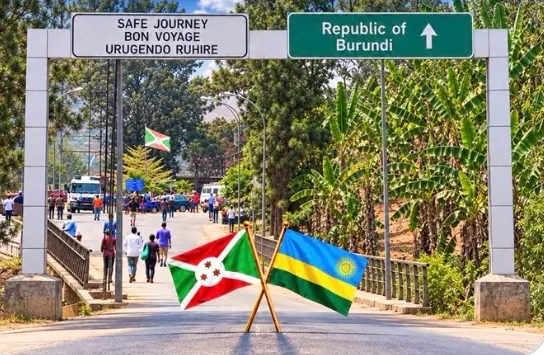
Rwanda's exports to Burundi have seen a significant increase, with the southern neighbor ranking among the top 7 export destinations for Rwandan products. According to Rwanda's National Institute of Statistics (NiSR), during the second quarter of 2026, Rwanda exported goods to Burundi valued at approximately $13.4 million. This represents more than double the amount from the previous quarter, indicating a growing demand for Rwandan products in Burundi.
Despite the prolonged border closure between Rwanda and Burundi, Rwandan products continue to find their way into Burundi, albeit through longer routes. The closure, which was ordered by the Gitega regime in January 2024, was a result of contentious diplomatic fallout between Kigali and Gitega. Burundi President Gen. Evariste Ndayishimiye accused Rwanda of hosting, training, and funding Red Tabara, a rebel group, which Rwanda's President Paul Kagame rejected.
The border closure was described as an "unfortunate decision" by President Kagame, who argued that it violated East African Community (EAC) principles of regional cooperation. The closure has led to Rwandan products being transported to Burundi through alternative routes, particularly via Tanzania, which lengthens journeys and increases costs. This has not deterred Rwandan exporters, with Burundi remaining a key market for their products.
Among the destinations for Rwandan exports, China holds the top spot, followed by the United Arab Emirates, the Democratic Republic of Congo, the Netherlands, the United States, the United Kingdom, and then Burundi in seventh place. The data from NiSR highlights the diversification of Rwanda's export market, with Burundi emerging as a significant customer for Rwandan goods.
The relationship between Rwanda and Burundi has been strained in recent years, with Burundi deploying troops in the Democratic Republic of Congo to fight alongside Congolese troops and FDLR and Wazalendo militia. The FDLR militia group, designated by Washington as a terrorist organization, is largely composed of perpetrators of the 1994 Genocide against Tutsi, which claimed more than a million lives.
Despite the tensions between the two countries, Rwanda's exports to Burundi continue to grow, driven by demand for Rwandan products. The two countries have a long history of trade, with Rwanda exporting goods such as coffee, tea, and minerals to Burundi. The growth in exports has contributed to Rwanda's economy, which has been experiencing steady growth in recent years.
The increase in exports to Burundi is a positive development for Rwanda's economy, which is heavily reliant on exports. The country's economy has been growing steadily, driven by sectors such as agriculture, tourism, and ICT. The growth in exports to Burundi is expected to continue, driven by the demand for Rwandan products in the neighboring country.
Key points
- Rwanda's exports to Burundi have more than doubled in the second quarter of 2026, valued at $13.4 million.
- Burundi ranks seventh among the destinations for Rwandan exports, after China, the United Arab Emirates, the Democratic Republic of Congo, the Netherlands, the United States, and the United Kingdom.
- The growth in exports to Burundi is a positive development for Rwanda's economy, which is heavily reliant on exports.