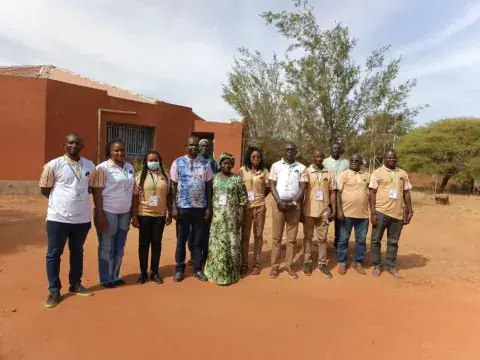
The commune of Pibaoré in Burkina Faso has shared its experience in land securization for internally displaced persons (IDPs) with the National Multi-Actor Platform on Land (PMAF). This was done during a field visit organized on the sidelines of the 3rd edition of the National Action Days on Land. The visit allowed participants to learn about the mechanisms put in place by Pibaoré to guarantee secure access to land for IDPs in a context of insecurity.
The experience of Pibaoré was shared despite the commune facing significant challenges, including the destruction of administrative infrastructure and the burning of the municipal office in October 2022. The commune has since rebuilt its administrative capacity with the support of the Project for Support to Decentralized Land Management, Conflict Prevention, and Management. This support enabled the reinforcement of the skills of the land agent, the training of village land commissions and conciliation commissions, and the provision of technical and computer equipment to the Rural Land Service.
The commune of Pibaoré adopted a participatory approach that involved municipal services, landowners, customary authorities, and IDPs. The process began with the identification of IDPs benefiting from land loans from local populations for agricultural activities. Landowners were then identified, and IDPs, landowners, and customary authorities were sensitized on the importance of formalizing land loan agreements and facilitating access to land for IDPs. The commune proceeded to issue Rural Land Possession Certificates (APFR) to landowners and formalized 18 land loans to IDPs.
A total of 111 APFRs were issued, enabling better management of transactions and securing the rights of different parties. The procedure for acquiring APFRs involves eight steps, including the submission of a request to the village land commission, verification, publication, and payment of taxes. Seydou Kouanda, the land agent, noted that the experience has provided valuable lessons, including the importance of strengthening the human and material capacities of communes for good land management.
The experience of Pibaoré has shown that secure access to land can be a means of solidarity, resilience, and integration for IDPs in their host communities. Kouanda emphasized the importance of involving landowners and customary authorities from the beginning of the process to prevent conflicts. Blaise Bama, coordinator of the PMAF, expressed satisfaction with the visit, highlighting the platform's desire to learn from successful experiences and document best practices.
The PMAF plans to document and capitalize on Pibaoré's experience before considering its replication in other localities facing similar challenges. This will enable the identification of best practices, shortcomings, and conditions necessary for potential scaling up. For the commune of Pibaoré, the prospects include continuing sensitization, supporting IDPs in land securization procedures, and strengthening collaboration with landowners and customary authorities.
The commune of Pibaoré has requested continuous support to strengthen the logistical and technical means of the land service, facilitating interventions on the ground. The experience of Pibaoré demonstrates that even in a difficult context, land securization can be a tool for peace and local development.
Key points
- The commune of Pibaoré has issued 111 Rural Land Possession Certificates (APFR) and formalized 18 land loans to internally displaced persons (IDPs).
- The experience of Pibaoré highlights the importance of strengthening the human and material capacities of communes for good land management.
- The National Multi-Actor Platform on Land (PMAF) plans to document and capitalize on Pibaoré's experience for potential replication in other localities.