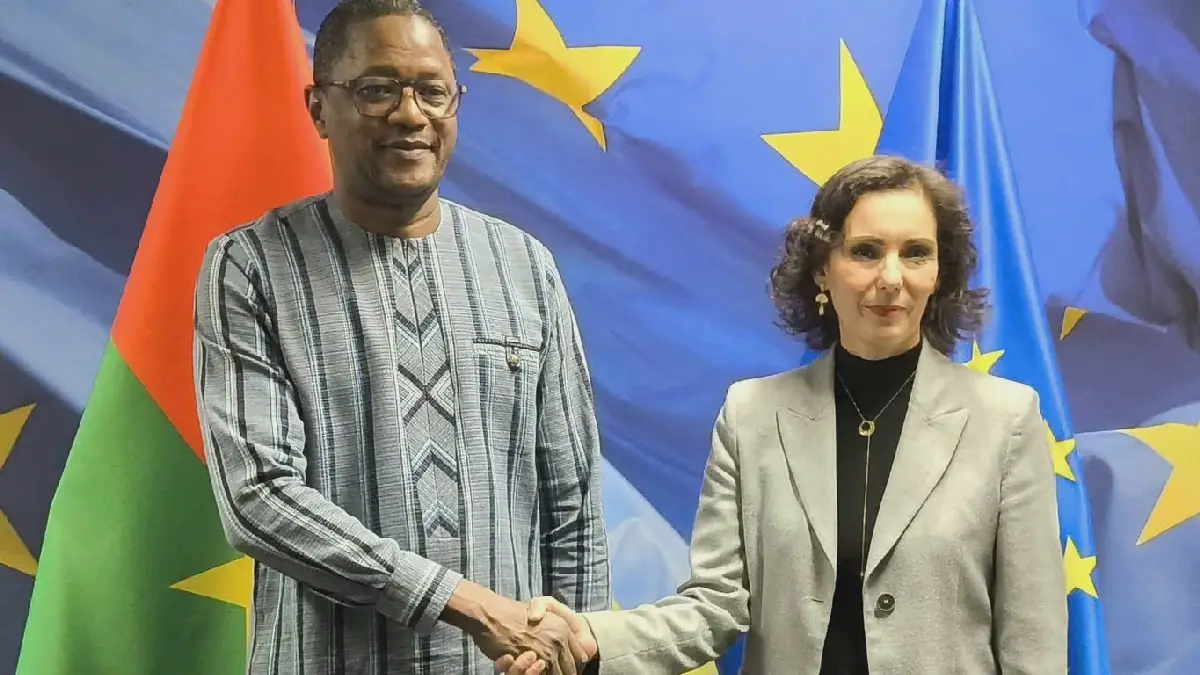
Burkina Faso's Foreign Minister, Karamoko Jean-Marie Traoré, recently met with European Commissioner for Humanitarian Aid, Hadja Lahbib, in Brussels to discuss humanitarian cooperation between Burkina Faso and the European Union. The meeting focused on a new approach to humanitarian aid, one that prioritizes sustainable support and structural projects in areas where displaced persons are returning. This approach aims to make populations autonomous rather than dependent on external aid.
Minister Traoré emphasized that Burkina Faso no longer wants "turnkey" aid imposed from outside, but rather support that is tailored to the country's specific needs and context. He criticized the practice of providing cash transfers, arguing that it can create dependency rather than encouraging self-sufficiency. Instead, Traoré advocated for prioritizing local actors who have a deep understanding of the terrain and can implement effective projects.
The discussions also touched on security concerns, with both parties stressing the importance of informing humanitarian workers about their role, limitations, and the country's rules. The Burkinabè government pledged to facilitate access to secure areas and provide protection to humanitarian workers, provided they respect national security requirements. This commitment is seen as a crucial step in ensuring the safety and effectiveness of humanitarian operations.
Commissioner Hadja Lahbib welcomed the progress made by Burkina Faso in reintegrating displaced persons into their communities of origin. She acknowledged the efforts of the Burkinabè government to create an environment conducive to the return of displaced persons and to support their reintegration. The two officials also discussed ways to improve coordination and cooperation between humanitarian actors and local authorities.
The new approach to humanitarian aid in Burkina Faso is part of a broader strategy to address the root causes of displacement and to support the country's development. By prioritizing sustainable and structural projects, the government aims to create lasting solutions for displaced persons and to promote economic growth and stability. This approach is seen as a model for other countries facing similar challenges.
The meeting between Minister Traoré and Commissioner Lahbib highlights the importance of adapting humanitarian aid to the specific needs and context of each country. By working together and sharing expertise, the European Union and Burkina Faso can develop more effective and sustainable solutions to address humanitarian challenges. This partnership is seen as a key step in promoting humanitarian cooperation and supporting development in the region.
The discussions between Burkina Faso and the European Union also underscore the need for a more nuanced understanding of humanitarian aid and its impact on local communities. By prioritizing local actors and sustainable projects, humanitarian aid can become a catalyst for development and autonomy, rather than dependency. This approach has the potential to transform the way humanitarian aid is delivered and to create lasting positive change in communities affected by crisis.
Key points
- Burkina Faso seeks sustainable humanitarian aid with structural projects to foster autonomy.