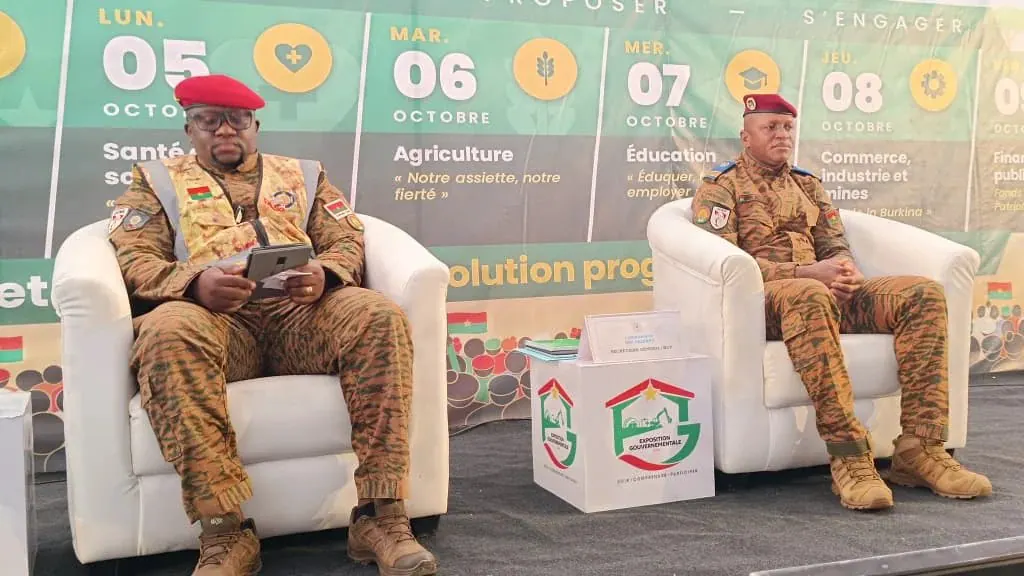
The Ministry of Construction in Burkina Faso has presented its achievements over the past four years, highlighting significant progress in infrastructure development. Representing the Minister of Construction, the Secretary General, Commandant Ollo Palenfo, presented the report on October 9, 2026, as part of the government's exhibition for the National Days of Patriotic Engagement and Citizen Participation (JEPPC). The report highlights the construction of over 1,000 km of rural roads, 340 km of urban roads, and 4,300 crossing structures.
The construction of rural roads has been a major focus, with over 1,000 km of roads built using mechanized methods and 150 km using high-intensity manual labor. Additionally, over 250 km of national and regional roads have been constructed, rehabilitated, or modernized, including the Bobo-Dioulasso-Orodara, Orodara-Banfora, and Orodara-Mali border axes. In major cities, over 340 km of urban roads have been developed and paved, including the Tensoaba Boulevard, Yennenga Avenue, and Mogho Avenue in Ouagadougou.
The Ministry has also made significant progress in improving crossing structures, with over 4,300 structures built, including the 72-meter-long Herredougou bridge on RN1, the Banakélédaga bridge, and the Bama multicellular culvert. Five mobile Unibridge-type bridges have been acquired to respond to emergency situations. Furthermore, the ministry has announced the resumption of rail traffic on the Ouagadougou-Bobo-Dioulasso-Banfora-Niangoloko axis.
The Ministry has also prioritized improving living conditions, with significant investments in sanitation. In Bobo-Dioulasso, 15.5 km of drains have been built, while in Kaya, 13.3 km of drains have been constructed. Additionally, 14 km of drains have been built in Ouahigouya and 40 km in Fada N'Gourma. Pilot operations to combat spontaneous housing have been launched on 1,172 hectares in Bobo-Dioulasso and 1,406 hectares in Ouagadougou.
The Ministry has also made progress in providing access to housing, with 1,515 homes built in several locations, including Ouagadougou, Bobo-Dioulasso, Kaya, Tougouri, and Dori. The ministry has also reported that 13,387 plots of land have been developed, including 10,087 plots developed by the National Urban Land Development Corporation (SONATUR) and 3,300 plots developed as part of the traders' city project.
The Ministry has also prioritized ensuring the quality and safety of constructions, with over 12,645 construction sites and 405 real estate promoter sites controlled. In Ouagadougou, 451 abandoned construction sites have been secured. The National Laboratory for Building and Public Works has been modernized, and the ministry has provided technical control for major investments, including universities, technical high schools, the Bobo-Dioulasso stadium, and the headquarters of the General Directorate of Taxes.
The Ministry has also undertaken significant reforms and modernization efforts, including the revision of the law on real estate promotion and the Urban Planning and Construction Code. The National Strategy for Cities 2027-2031 has been adopted, and a digital platform for bail agent cards has been launched, allowing for the creation and issuance of 532 cards. The ministry has also established a one-stop shop for construction and development permits.
Key points
- The Ministry of Construction has reported significant progress on infrastructure development, including the construction of over 1,000 km of rural roads and 4,300 crossing structures.
- The Ministry has prioritized improving living conditions, with significant investments in sanitation and access to housing.
- The Ministry has also undertaken significant reforms and modernization efforts, including the revision of key laws and the adoption of a national strategy for cities.