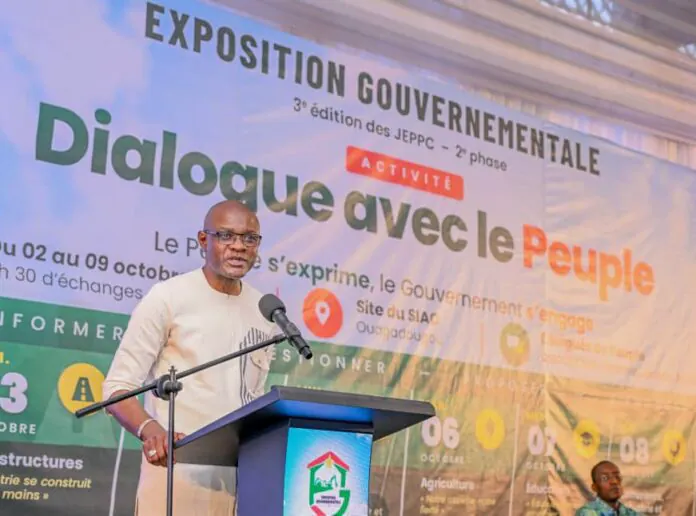
On October 8, 2026, the Ministry of Energy, Mines, and Quarries (MEMC) took center stage at the government exhibition during the second phase of the third edition of the National Days of Patriotic Engagement and Citizen Participation (JEPPC). Minister Yacouba Zabré GOUBA, alongside his counterpart in charge of Industry, Commerce, and Artisanal, presented the achievements of their respective departments over the past four years of the Revolutionary People's Party (RPP). This exercise in accountability was marked by direct exchanges with citizens.
The event, which took place in a dedicated room for accountability, saw the two government members engage in a transparent discussion with a large audience. Citizens posed questions, expressed concerns, and sought clarifications on actions taken and results obtained. Minister GOUBA began by saluting the commitment of combatant forces, whose actions contribute to the realization of activities in the energy, mining, and quarrying sectors. He also praised the agents of his department, highlighting their contribution to the presented results.
In the energy sector, Minister GOUBA noted that Burkina Faso faced significant dependence on electricity imports in 2022, with imports accounting for around 58% of national supply. To reverse this trend, several reforms were implemented, including the modernization of regulatory texts, reorganization of structures, and strengthening of national production capacities. The interventions on existing installations allowed for the recovery of 100 megawatts (MW) of power. Additionally, new production capacities were developed, with installed power increasing from 501 MW to over 812 MW between 2022 and October 2026.
Minister GOUBA also highlighted progress in rural electrification, with the rate increasing from around 6% to nearly 12% over four years. Over 315 new localities were electrified, and 25,000 streetlights were deployed in the previous year. Furthermore, over 10,000 kits were made available to internally displaced persons between 2022 and 2025. The minister outlined an ambitious plan to reach an installed power of around 2,500 MW by 2030, with sustained efforts to install new capacities to meet household, rural, and industrial needs.
In the mining sector, Minister GOUBA emphasized the desire to control the entire value chain, from knowledge of the subsoil to exploitation and transformation of resources. This orientation was reflected in the 2024 reform of the Mining Code and the consideration of local content. Innovations include the increase in the state's free participation in mining projects to 15% and the possibility for the state to raise its participation to at least 30% for a fee. The creation of the Burkinabé Mining Participation Company (SOPAMIB) is another lever in this policy.
The minister reported that seven mining projects are currently under development, with a goal of increasing this number to ten in the medium term. He also mentioned semi-mechanized mining projects led by national actors and the planned resumption of Perkoa's exploitation. The constitution of a national gold reserve, strengthening the capacities of the national geological service, and local transformation of resources are also among the measures implemented. Golden Hand is involved in the treatment of mining residues, while the establishment of a refinery aims to increase the added value created in Burkina Faso before exporting gold.
Minister GOUBA concluded by emphasizing the need to consolidate the results obtained and maintain the momentum. The goal is to ensure that the exploitation of national resources benefits current populations while preserving the interests of future generations. The minister's presentation was followed by a question-and-answer session, during which citizens appreciated the efforts made and expressed their expectations for the future. KEY_POINT: Minister Yacouba Zabré GOUBA presented achievements in energy, mining, and quarrying sectors during the 2026 JEPPC event. KEY_POINT: Burkina Faso aims to increase its installed power to around 2,500 MW by 2030. KEY_POINT: The country seeks to control the entire value chain in the mining sector, from knowledge of the subsoil to exploitation and transformation of resources.