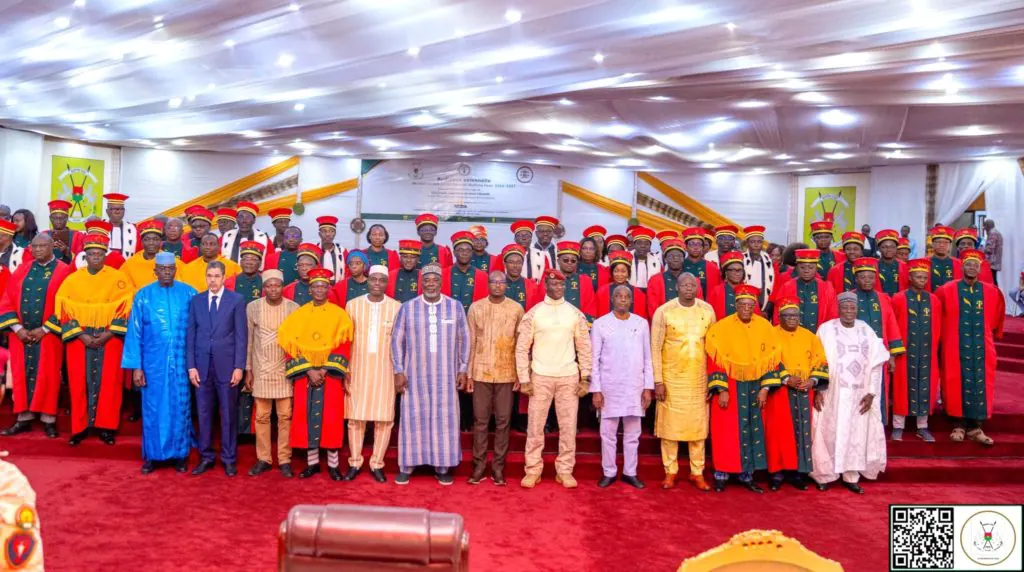
The Burkinabè judiciary has officially begun its 2026-2027 judicial year with a solemn audience in Ouagadougou, held under the patronage of President Ibrahim Traoré. The event, themed "Apport des mécanismes traditionnels de règlement des litiges pour un meilleur accès à la justice au Burkina Faso" (Contribution of traditional dispute resolution mechanisms for better access to justice in Burkina Faso), highlights the country's efforts to enhance access to justice. The ceremony was attended by several high-profile figures, including representatives from member countries of the Alliance des Etats du Sahel (AES).
The audience solennelle was attended by Mamadou Kassogué, Mali's Minister of Justice and Human Rights, who expressed satisfaction with the event. Kassogué stated that the theme was very relevant and reflected the desire of AES member countries to promote a more Africanized approach to judicial practices. He noted that Mali and Niger are already engaged in similar initiatives and that this event would serve as an inspiration for their own efforts.
Me Edasso Rodrigue Bayala, Burkina Faso's Minister of Justice and Human Rights, emphasized that the solemn audience aimed to review the previous year's achievements and assess the current state of the judiciary. He highlighted the significance of the law on Faso Bu Kaooré, which aims to promote traditional dispute resolution mechanisms. Bayala believes that these mechanisms will greatly improve access to justice in the country.
According to Bayala, the law on Faso Bu Kaooré has been well-received by stakeholders, who are already ahead of schedule in preparing its implementation. He reaffirmed his department's commitment to supporting the rollout of this reform, with the goal of making justice in Burkina Faso a reality that reconciles and unites the population.
Pascal Bamouni, First President of the Court of Cassation, stressed the importance of effectively implementing the law on Faso Bu Kaooré. He noted that ongoing discussions around this law aim to strengthen its orientation, explanation, and sensitization among stakeholders. Bamouni believes that this will lead to better appropriation and effective implementation of the mechanisms provided.
The 2026-2027 judicial year's focus on traditional dispute resolution mechanisms marks a significant shift in Burkina Faso's approach to justice. By embracing these mechanisms, the Burkinabè judiciary aims to become more responsive to social realities and endogenous practices. This approach is expected to bring justice closer to the population and promote a more inclusive and reconciliatory justice system.
The event was also attended by other dignitaries, showcasing the strong regional interest in Burkina Faso's judicial reforms. The country's efforts to revamp its justice system have been closely watched by neighboring countries, which see potential benefits in adopting similar approaches. As Burkina Faso moves forward with its judicial reforms, the international community will likely be monitoring its progress.
Key points
- The Burkinabè judiciary has begun its 2026-2027 judicial year, focusing on incorporating traditional dispute resolution mechanisms to enhance access to justice.