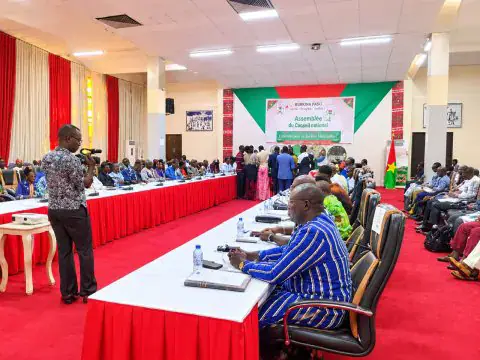
The 7th ordinary general assembly of Burkina Faso's Haut Conseil national de la recherche scientifique et de l'innovation (HCNRSI) was held on November 23, 2026, in Ouagadougou. The assembly brought together researchers, traditional practitioners, and stakeholders from various ministries and institutions. The event was presided over by the Minister of Higher Education, accompanied by his colleagues in charge of Health, Secondary Education, and Digital Transition. The assembly focused on the theme of endogenous knowledge and the sustainability of health systems.
The assembly featured several communications, including an overview of medical research and the development of a national phytomedicine industry in Burkina Faso. Other presentations discussed traditional medicine and its collaboration with scientific research, as well as the report of the Interministerial Working Group (GTI). The Minister of Research, Pr Adjima Thiombiano, emphasized the strategic role of HCNRSI in promoting scientific research and innovation. He highlighted the importance of integrating traditional medicine into healthcare services.
According to Minister Thiombiano, traditional medicine and pharmacopoeia are rich heritage passed down from previous generations. They remain the primary resort for many communities for primary healthcare and the management of certain complex pathologies. He noted that approximately 11,000 traditional medicine practitioners are registered in Burkina Faso, with 500 formally recognized by the Ministry of Health. These practitioners collaborate with health and research structures in managing various pathologies.
Despite the potential of traditional medicine, Minister Thiombiano expressed concern that its integration into healthcare services is limited. He cited the example of dengue fever, which is currently affecting the country. The minister emphasized the need to intensify research and development on medicinal plants through multidisciplinary teams. This would enable the valorization of local plant resources and improve healthcare services.
The HCNRSI assembly formulated several recommendations to promote the integration of traditional medicines into public healthcare. These recommendations include intensifying research in ethnopharmacology and clinical trials, modernizing technical platforms in higher education and research institutions, and structuring the value chain of medicinal plants. The assembly also recommended integrating traditional medicines into public healthcare circuits and promoting the rational cultivation of medicinal plants.
Furthermore, the assembly suggested establishing bosquets provinciaux to preserve ecosystems and applying the Nagoya Protocol on access and benefit-sharing. The recommendations also include creating public-private financing mechanisms to support the development of traditional medicine. The government plans to establish a mixed research team to work on specific pathologies, including dengue fever.
The integration of traditional medicines into public healthcare in Burkina Faso aims to improve healthcare services and promote endogenous knowledge. The HCNRSI recommendations will be implemented to valorize local plant resources, enhance research and development, and provide better healthcare services to the population. The government's commitment to promoting traditional medicine and scientific research is expected to contribute to the country's healthcare development.
Key points
- The HCNRSI recommends integrating traditional medicines into public healthcare circuits to improve healthcare services in Burkina Faso.
- The government plans to establish a mixed research team to work on specific pathologies, including dengue fever.
- The recommendations include intensifying research in ethnopharmacology and clinical trials, modernizing technical platforms, and structuring the value chain of medicinal plants.