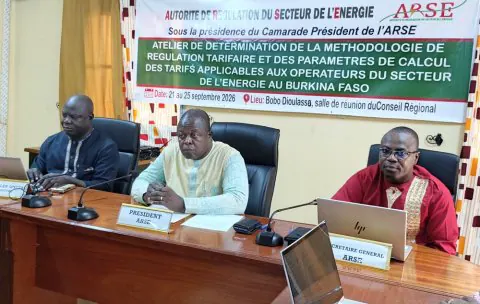
A five-day workshop is underway in Bobo-Dioulasso, Burkina Faso, to determine a methodology for regulating tariffs in the country's electricity sector. The event, which began on September 21, 2026, is organized by the Autorité de régulation du secteur de l'énergie (ARSE). Dr. Jean-Baptiste Ky, president of ARSE, emphasized the importance of a reliable, sustainable, and affordable energy supply for economic competitiveness, improved living conditions, and national sovereignty.
The workshop brings together stakeholders from various sectors, including the Prime Minister's office, ARSE, the Ministry of Energy, the Société nationale d'électricité du Burkina (SONABEL), and independent electricity producers. The goal is to develop a shared framework for tariff regulation, taking into account economic and technical realities, as well as user interests. Dr. Ky highlighted the challenges facing the sector, including volatile fuel prices, budget constraints, and emerging economic models.
The legal framework, specifically Law No. 014-2017/AN and Decree No. 2018-0568, mandates ARSE to play a central role in regulating the energy sector. To fulfill this mission, a clear, objective, and predictable methodological framework is needed. The workshop aims to examine current tariff practices, analyze different regulation methodologies, and determine the necessary parameters for calculating tariffs.
The five-day workshop will enable participants to review the regulatory framework, analyze different methodologies, and determine the parameters needed to calculate tariffs. They will also define rules for independent electricity producers and establish mechanisms for revising, indexing, and controlling tariffs. The approach seeks to balance the financial viability of operators, sector sustainability, investment needs, and electricity accessibility for users.
According to Dayangnewendé Isaac Kabré, Director of Economic and Tariff Studies at ARSE, the 2018 decree outlines three tariff regulation methodologies but does not specify which one to adopt. The workshop aims to consensually determine the most suitable methodology for the Burkinabè context. The expected outcome is a reference framework that will guide decision-making for ARSE and the Ministry of Energy.
The workshop's results are expected to strengthen the tariff framework, enhance transparency, and foster trust among sector stakeholders. The framework will constitute a decision-making tool for ARSE and the Ministry of Energy, contributing to the sector's sustainability and development. Participants are committed to actively engaging in discussions to develop a methodology adapted to the Burkinabè energy sector's realities and prospects.
At the end of the workshop, the main technical and economic parameters will be identified, and orientations for developing an adapted methodology will be formulated. The framework resulting from these consultations will help ensure a reliable, sustainable, and affordable energy supply for Burkina Faso's economic growth and development.
Key points
- The workshop aims to establish a tariff regulation methodology that balances financial viability, investments, and accessibility in Burkina Faso's electricity sector.