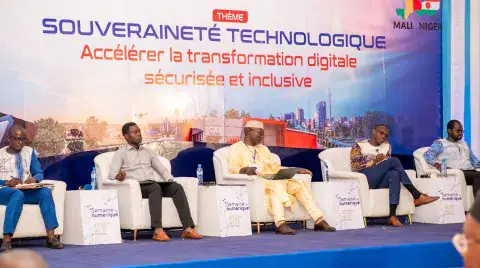
The 21st edition of Burkina Faso's Digital Week 2026 is currently taking place at the Exhibition Park of the Ouagadougou International Artisanal Fair. Discussions during the second day of the event centered on several challenges related to the country's technological sovereignty. These challenges include the adoption of open-source technologies, the development of artificial intelligence in local languages, and the formation of local skills. The talks were moderated by Abdoul Kader Ky, the National Director of Digital Economy of Niger.
According to Idriss Tinto, Technical Advisor at the Ministry of Digital Transition, Posts, and Electronic Communications, open source is a lever for sovereignty. He emphasized that access to source codes allows for the adaptation of existing solutions and reduces dependence on large platforms. Tinto warned against the risks associated with relying on external providers of artificial intelligence, such as tariff increases, access restrictions, or service interruptions. He advocated for local skills capable of maintaining tools and ensuring the country's technological autonomy.
Dr. Rodrigue Kafando, a teacher-researcher at the Virtual University of Burkina Faso and research fellow at the Center of Excellence in Artificial Intelligence, presented work on four local languages: Mooré, Dioula, Fulfuldé, and Gulmancema. The teams are adapting existing models, particularly those from Meta's NLLB family, using locally collected data. Kafando identified the scarcity of varied resources as the main obstacle to progress. He suggested expanding data collection to include translations, transcriptions, and vocal recordings of everyday life.
Ounténi T. Cyril Ouoba, Director General of RIGO, identified five priority training areas: software engineering, infrastructure, cybersecurity, data, and artificial intelligence, as well as commercialization. He stressed that the ecosystem is insufficient, as a technical innovation does not become a viable product without marketing skills. Ouoba called on the state and large enterprises to use local solutions more extensively, with public procurement representing a significant outlet. He recommended short training courses for young people and out-of-school women.
Bourhanoud-Dine Sawadogo, Economic and Financial Analysis Officer at the Burkinabè Fund for Economic and Social Development, recalled the experience of the Burkina Startups initiative launched in 2017 with an announced envelope of 10 billion CFA francs. The goal was to create 500 start-ups. However, the initiative revealed shortcomings in the preparation and support of certain project leaders. Sawadogo emphasized the need to evaluate real needs before mobilizing funds.
The discussions during Burkina Faso's Digital Week 2026 highlighted the importance of supporting start-ups and local skills to ensure the country's technological sovereignty. The event brought together various stakeholders, including experts, researchers, and entrepreneurs, to discuss the challenges and opportunities in the digital sector. The talks also underscored the need for collaboration between developers, users, and institutions to promote innovation and digital development.
Key stakeholders, including government officials, researchers, and entrepreneurs, are advocating for a comprehensive approach to support the growth of the digital sector in Burkina Faso. This approach includes investing in education and training, promoting open-source technologies, and encouraging the development of local languages and content. By working together, these stakeholders aim to create a vibrant and sustainable digital ecosystem that drives economic growth and social progress.
Key points
- The event highlighted the need for local skills and open-source technologies to ensure Burkina Faso's technological sovereignty.
- The development of artificial intelligence in local languages is crucial for promoting digital inclusion and access to information.
- Supporting start-ups and entrepreneurs is essential for driving innovation and economic growth in the digital sector.