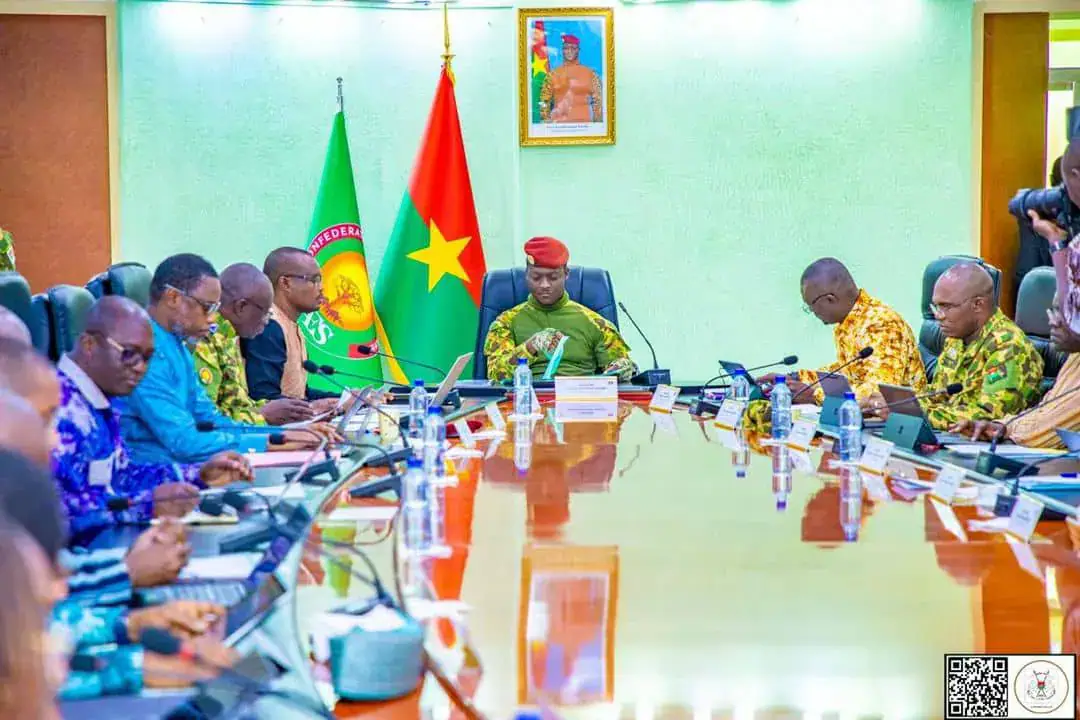
On November 5, 2026, Burkina Faso's President, Captain Ibrahim Traore, led the weekly Council of Ministers meeting. The session examined and adopted several key dossiers, making important decisions for the country's progress, in line with the vision of the Revolutionary People's Progressive Movement (RPP). According to Government Spokesperson, Gilbert Ouedraogo, the council addressed various sectors, including energy, mines, health, and sports.
The Council adopted three decrees under the Ministry of Energy, Mines, and Quarries. The first decree established conditions and modalities for reorganizing illegal mining sites, sites involved in conflicts, and strategic sites. This aims to create a peaceful climate for artisanal gold exploitation. Minister Yacouba Zabre Gouba stated that any actor employing children on mining sites would face the full rigor of the law. The second decree created a state-owned company, Faso SANU, to better organize the sub-sector and provide a technical arm for managing the first decree.
Faso SANU will be owned 50% by the National Precious Substances Company (SONASP) and 50% by the Public Treasury. The third decree adopted the statutes of Faso SANU. These decisions aim to improve the organization of artisanal mining and provide a technical arm for the state. According to Minister Gouba, this will help to better regulate the sector and provide a more stable environment for artisanal miners.
Under the Ministry of Health, the Council adopted a decree modifying the department's organigram. This change aligns with the new territorial division and the establishment of Communal Medical Centers (CMC). The goal is to effectively implement the President's vision for public health. The restructuring includes creating a Deputy Secretary General to supervise hospital structures and state-owned companies.
The health sector restructuring also involves establishing specialized structures, such as the Permanent Secretariat of the National Council for the Fight Against AIDS, ISTs, viral hepatitis, and tuberculosis. Additionally, the Faso Center for Disease Control and Prevention (Faso CDC) and the Burkinabe Traditional Medicine Agency were created. This aims to promote the national medical heritage and strengthen the territorial network with provincial health directions and hospital centers.
The Council also adopted a bill to develop sports activities, aiming to address the shortcomings of the 2019 law on sports and leisure orientation. The Minister for Sports, Annick Lydie Djouma Pikbougum/Zingue Ouattara, stated that this revision seeks to align the country's ambitions, define a clear vision, and establish a concerted action plan to transform the sports sector into a socio-economic development engine.
Key innovations in the sports bill include social and salary protection for athletes, government authorization for international team participation, inclusive sports for people with disabilities, and strengthened rules on athlete health and anti-doping. These changes aim to promote a more structured and effective sports sector in Burkina Faso.
Key points
- The Burkinabe government has taken steps to reorganize the artisanal mining sector and promote public health through the creation of new institutions and the adoption of key legislation.
- A new bill on sports development aims to transform the sector into a socio-economic driver, with a focus on athlete protection and anti-doping measures.
- The Council of Ministers' decisions reflect the government's efforts to implement its vision for the country's progress, as outlined in the Revolutionary People's Progressive Movement (RPP).