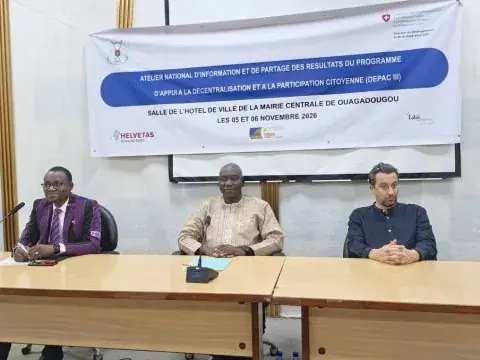
The city of Ouagadougou is hosting a two-day national workshop from November 5-6, 2026, to review the achievements of the third phase of the Decentralization and Citizen Participation Support Program (DEPAC 3). The program, implemented since 2015 in three phases, aims to ensure equitable and inclusive access to quality infrastructure and public services for local populations. DEPAC 3, which ran from 2022 to 2026, was deployed in 26 communes by a consortium led by Helvetas, with financial support from the Swiss Cooperation.
DEPAC 3 focused on two main areas: citizen participation and accountability, including social cohesion and peace promotion, and support for economic planning and local government mastery. The program accompanied local authorities, central government services, civil society organizations, media, and other development actors. It contributed to strengthening the capacity of local governments to autonomously manage infrastructure and improved access to basic social services and economic equipment. The program also promoted citizen participation, accountability, and the transfer of tools and best practices to local actors and national institutions.
Jean-Pierre Salambéré, program manager at the Swiss Cooperation office in Burkina Faso, expressed satisfaction with the program's achievements, highlighting infrastructure development, citizen accountability practices, new financing instruments, and socio-economic desclaving of local governments. He emphasized that DEPAC has significantly contributed to strengthening local government resilience and that the Swiss Cooperation is committed to continuing its support for decentralization dynamics in Burkina Faso.
The program's impact includes capacity building for local governments, improved access to social services, and enhanced citizen participation. Saïdou Sankara, secretary general of the Ministry of Territorial Administration and Mobility, acknowledged the significant role DEPAC has played in the decentralization process, particularly in promoting a culture of local mastery and citizen engagement. He stressed that sustainable development requires the conscious involvement of populations and that local governments must have the autonomy to implement national policies.
The workshop serves as a platform for stakeholders to share experiences, tools, and best practices developed during DEPAC 3's implementation. Participants will discuss prospects for sustaining the program's achievements and explore mechanisms for perpetuating its impact. The event aims to capitalize on lessons learned and share experiences to inform future decentralization initiatives.
The third phase of DEPAC was implemented in 26 communes, with a focus on strengthening local government capacities and promoting citizen participation. The program's achievements include infrastructure development, improved access to social services, and enhanced accountability. Stakeholders are committed to building on these successes to ensure the long-term sustainability of DEPAC's impact.
The sustainability of DEPAC's achievements is a key concern, with stakeholders exploring ways to perpetuate the program's impact. The Swiss Cooperation has expressed its commitment to continuing its support for decentralization dynamics in Burkina Faso, and the government has emphasized its intention to build on DEPAC's achievements to strengthen local governments and promote sustainable development.
Key points
- The DEPAC 3 program has contributed to strengthening local government resilience and promoting citizen participation in Burkina Faso.