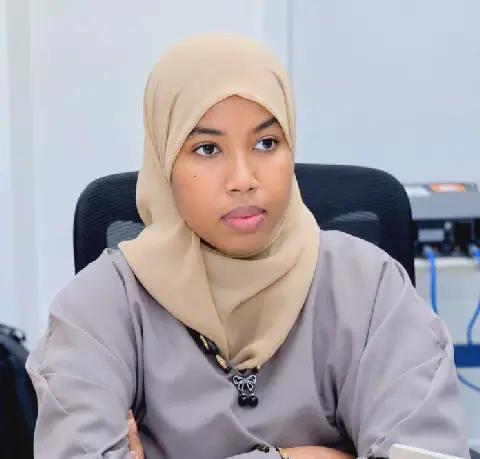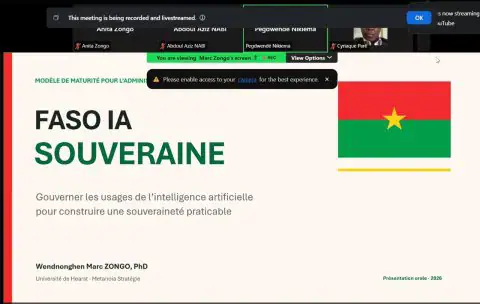
Dr. Marc Zongo, a researcher at the University of Hearst in Canada, recently presented a proposed maturity model called "Faso IA Souveraine" to enhance the sovereignty of artificial intelligence in Burkinabé public administration. This model aims to help public administrations evaluate, monitor, and improve their use of AI. The presentation was made during an online conference as part of the second edition of Le Faso Digital, a virtual fair for digital solutions.
The "Faso IA Souveraine" model focuses on five key areas of analysis: visibility of AI use, techniques and processes employed, user knowledge and critical capacity, tool appropriation by agents, and institutions and rules governing their use. The model also identifies four levels of maturity, ranging from uncontrolled adoption of AI tools to adapted and governed use. This approach enables each structure to determine its current situation, set realistic objectives, and monitor improvements.
Dr. Zongo emphasized that AI sovereignty is not limited to possessing infrastructure or developing national technologies but also relies on the ability of organizations to monitor the use of available tools, including those designed abroad. The "Faso IA Souveraine" model provides a framework for analysis, allowing administrations and organizations to assess their level of maturity in AI use, identify shortcomings, and define improvement actions.
The proposed model comprises several steps, including mapping AI use, establishing a diagnosis, measuring gaps between existing practices and the desired level, adapting tools, skills, rules, and data management, and ensuring periodic monitoring. The process is not necessarily linear and may need to be adjusted based on encountered difficulties.
During the conference, participants raised concerns about data protection, AI tool reliability, and risks associated with their use in public services. The issue of using free or paid versions of AI tools was also discussed, with consultant Valerio Coulibaly questioning the risks of exposing data when administrations use publicly accessible solutions to process sensitive information.
The importance of protecting sensitive information, such as through encryption or concealment of certain personal data, was highlighted. Dr. Zongo recalled the relevance of Burkinabé legislation on personal data protection but stressed that AI sovereignty cannot be reduced to the existence of legal texts. It also requires internal governance mechanisms, adapted skills, and the ability to monitor actual practices.
The media sector was also discussed, with Dr. Cyriaque Paré mentioning the need for common rules on AI use in newsrooms. Dr. Zongo expressed interest in this topic and noted that he is currently conducting research that could enable a comparison between the practices of media outlets in the North and South.
Key points
- The "Faso IA Souveraine" model aims to help Burkinabé public administrations assess and improve their use of artificial intelligence.
- The model focuses on five key areas of analysis and identifies four levels of maturity.
- The approach enables each structure to determine its current situation, set realistic objectives, and monitor improvements.