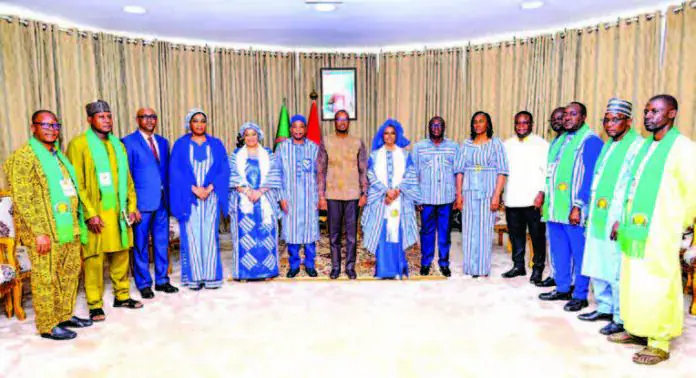
On November 13, 2026, Burkina Faso's Prime Minister, Rimtalba Jean Emmanuel Ouédraogo, met with ministers from the Alliance of Sahel States (AES) countries, including Mali and Niger. The delegation comprised ministers responsible for public service, labor, employment, and social protection. They were accompanied by Burkina Faso's Minister of Public Service, Mathias Traoré, and Minister of Sports, Youth, and Employment, Annick Lydie Pikbougoum.
The meeting followed a gathering of ministers from the three AES countries in Ouagadougou, where they discussed implementing the second-year roadmap of the AES Confederation. This came after preparatory talks among senior officials took place from November 10-12, 2026, in the Burkinabé capital. Mali's Minister of Labor, Public Service, and Social Dialogue, Fassoun Coulibaly, spoke on behalf of the delegation after the audience with the Prime Minister.
Coulibaly explained that the ministers aimed to present the outcomes of their meeting to the Prime Minister and seek his guidance. The Prime Minister welcomed the meeting and encouraged the ministers to use the ongoing reforms to improve public services for citizens. He also urged them to continue efforts to decolonize mentalities within public administrations. According to Coulibaly, the Prime Minister's orientations emphasized making good practices a source of hope for citizens and building a public service that serves the people.
During their meeting, the ministers examined and adopted four key documents. The first document is a guide to good practices in public service, which will serve as a common reference for the administrations of the three countries. Two other documents focus on professional mobility, aiming to simplify procedures for workers within the AES space. The fourth document is a convention on the portability of social benefits, ensuring that workers' social rights are continuous across AES countries.
The convention on social benefits portability will allow workers to accumulate social benefits across different AES countries. For instance, a worker could start contributing in Mali, continue in Burkina Faso, and receive their retirement pension in Niger. This move aligns with the AES's goal of creating a unified space where citizens can move freely and enjoy equal opportunities.
The AES countries - Burkina Faso, Mali, and Niger - share the motto "One space, one people, one destiny." Building this common space involves removing obstacles to free movement and providing guarantees for citizens to settle in any member country. The public services of these countries play a crucial role in achieving this goal, and the Ouagadougou meeting marks a significant step toward that objective.
The reforms and agreements discussed are part of a broader effort to enhance cooperation and integration among AES member states. By harmonizing practices and policies, the countries aim to improve public services, promote professional mobility, and ensure social protection for their citizens. These developments reflect the ongoing commitment to deepening regional cooperation and achieving the AES's vision of a unified and prosperous space for its people.
Key points
- The meeting discussed implementing reforms to improve public services and social protection for citizens across AES countries.