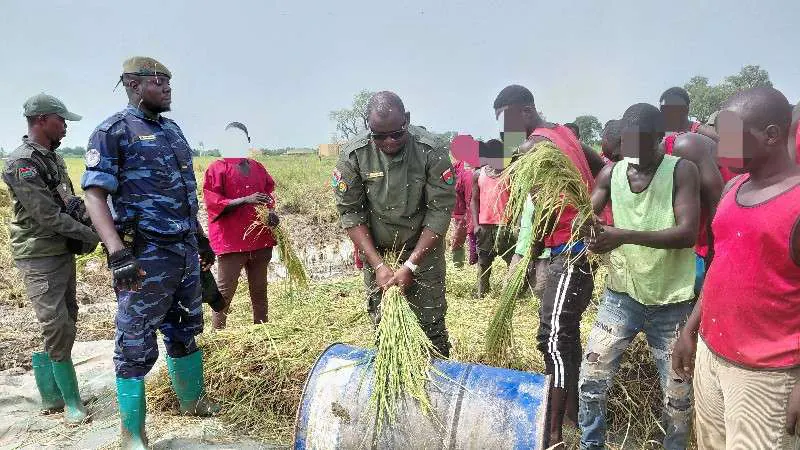
The Burkinabé government has made significant strides in its agricultural initiatives within the country's prison system. On October 9, 2026, Justice Minister Me Edasso Rodrigue Bayala visited the Baporo Agricultural Penitentiary Center, where he commended the dedication of both the inmates and prison staff. He highlighted the crucial role of government support in achieving these impressive results. The center at Baporo is anticipated to produce 550.2 tons of cereals and legumes during the 2026-2027 campaign.
The Baporo center is cultivating various crops, including rice, maize, sorghum, cowpeas, and sesame. Specifically, rice is being grown on 90 hectares, with an expected yield of 225 tons. Maize cultivation spans 85 hectares, projected to produce 212 tons, while sorghum covers 63 hectares, expected to yield 94 tons. Additionally, cowpeas are grown on 20 hectares, anticipated to produce 16 tons, and sesame on 5 hectares, with an estimated yield of 3.2 tons. These efforts demonstrate a diversified agricultural approach within the prison system.
Minister Bayala attributed the success of the Baporo center to inter-ministerial cooperation, particularly between the Ministries of Justice and Agriculture. The Ministry of Agriculture provides technical support, including the provision of seeds, fertilizers, and agricultural expertise. He noted that since 2024, the Ministry of Justice has not had to purchase cereals for inmate sustenance, focusing instead on condiments and other complementary needs. This self-sufficiency is a significant step towards sustainability.
The Baporo center has expanded considerably, from approximately 15 hectares of arable land in 2022-2023 to over 300 hectares, with more than 260 hectares planted for the current campaign. Minister Bayala expressed satisfaction with the progress, noting that the center is already harvesting rice and nearing maturity with maize. However, he acknowledged that pockets of drought have affected the crops. Nationally, the prison administration expects a total production of 1,014.7 tons for the 2026-2027 campaign on 574 hectares across various establishments.
Ten key centers have been selected to intensify agricultural activities, receiving inputs such as seeds, NPK fertilizer, and urea, along with free plowing services in partnership with the Ministry of Agriculture. Besides Baporo, other notable centers include Banfora, which expects 150 tons on 76 hectares, and Sourgoubila, Bobo-Dioulasso, and Gaoua, each projecting 50 tons on 42, 40, and 20 hectares, respectively. These centers contribute significantly to the national production target.
Minister Bayala emphasized the importance of preserving the harvests until storage to ensure that the efforts invested in planting and crop maintenance translate into tangible results. He also highlighted the new penitentiary orientation that enables inmates to engage in productive activities and acquire useful skills for their reintegration into society. The minister announced plans to introduce training workshops in livestock, fish farming, welding, and carpentry to complement agricultural activities.
The visit also underscored the living conditions and reintegration prospects of inmates. Minister Bayala stressed that prisons should not only house inmates but also enable them to contribute to the country's food self-sufficiency. He mentioned revising the legal framework to expand access to the community service system, allowing more inmates to benefit from it. The inmates' representative expressed gratitude for the initiatives and commitment to achieving the set production targets.
Key points
- The Baporo Agricultural Penitentiary Center is expected to produce 550.2 tons of cereals and legumes for the 2026-2027 agricultural campaign.
- Nationally, the prison administration anticipates a total production of 1,014.7 tons for the 2026-2027 campaign.
- The collaboration between the Ministries of Justice and Agriculture has been instrumental in the success of prison farms.