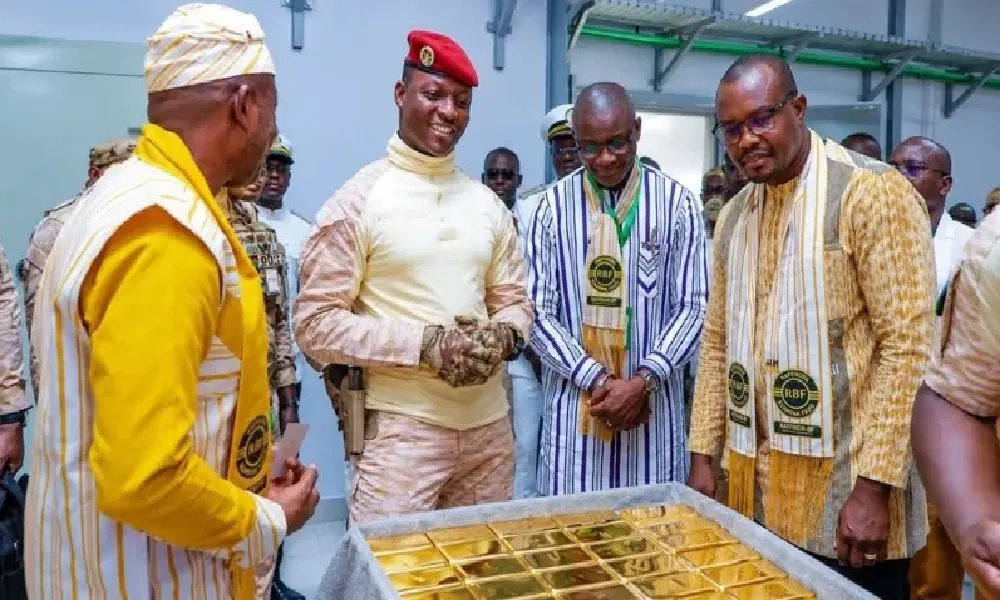
Burkina Faso has inaugurated its first national gold refinery, marking a major step in the government’s drive to increase local processing and retain more value from its mineral resources. The state-backed Raffinerie Nationale d’Or du Burkina Faso (RAFFINOR-BF), located in Ouagadougou, will refine, assay, certify, and securely store gold locally.
The $19 million facility has an initial annual capacity of 164 tonnes, with a second phase expected to raise that capacity to 515 tonnes. Gold remains the backbone of Burkina Faso’s export economy, accounting for more than 80 per cent of exports according to the IMF, while current reporting citing government figures puts its share of export earnings at nearly 94 per cent in the first seven months of 2026.
President Ibrahim Traoré inaugurated the Raffinerie Nationale d’Or du Burkina Faso (RAFFINOR-BF) in Ouagadougou on Monday, September 28, describing the facility as an important step towards greater control of the country’s natural resources. The refinery, built at a cost of more than 11 billion CFA francs ($19 million), is expected to allow Burkina Faso to undertake activities including gold refining, assaying, certification and secure storage domestically.
Traoré said his administration no longer wanted Burkina Faso to remain a country that simply extracts minerals and exports them for processing elsewhere. “Our ambition is no longer to be a country that simply extracts and ships its raw materials abroad. We want to refine all our metals locally … we want to have the entire value chain here,” Traore said.
The government has presented the refinery not merely as a gold-processing facility but as part of a wider effort to increase the country’s capacity to control, process and commercialise its natural resources. RAFFINOR-BF has an initial refining capacity of 164 tonnes of gold annually. According to the government, the facility has been designed in phases, with a second stage expected to increase capacity to 515 tonnes per year.
The project cost more than 11 billion CFA francs, equivalent to about $19 million, and was financed principally by the Burkinabè state through SONASP, in partnership with domestic private-sector interests. The refinery’s capacity is considerably higher than Burkina Faso’s recorded annual production in recent years, but officials say the long-term objective is not only to process domestic production but also to establish the country as a regional centre for gold refining.
Government figures presented earlier this year showed that the country produced more than 94 tonnes of gold in 2025, representing an increase of more than 30 tonnes from the previous year. About 43 tonnes came from artisanal and semi-mechanised operations, according to figures presented by the government. World Gold Council data also puts Burkina Faso’s 2025 mine production at about 94 tonnes, placing it among Africa’s significant gold producers.
Key points
- The refinery is expected to create approximately 100 direct jobs and more than 5,000 indirect jobs.
- Gold has become the backbone of Burkina Faso’s extractive economy over the past two decades.
- The government suspended the issuance of export permits for artisanal and semi-mechanised gold and other precious commodities in February 2024.