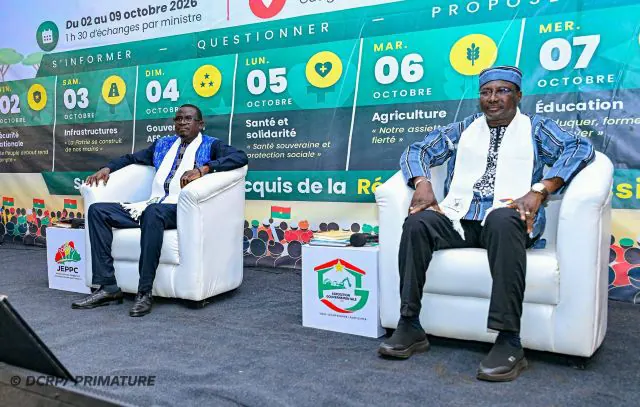
On October 7, 2026, the Ministers of Secondary Education and Technical Training, Pr Moumouni Zoungrana, and Basic Education, Literacy, and Promotion of National Languages, Jacques Sosthène Dingara, co-led a session of the "Dialogue with the People" activity at the SIAO's Soleil Levant Pavilion in Ouagadougou. This event was part of the government's exposition during the second phase of the National Days of Patriotic Engagement and Civic Participation (JEPPC). The meeting aimed to present reforms to the national education system and address citizen concerns.
Jacques Sosthène Dingara outlined actions taken to improve access to basic education, learning quality, and school governance. He mentioned the development of preschool education, recruitment of educators, and construction of new infrastructure, including R+3 buildings designed to optimize school space. The reforms also focus on integrating sociocultural and environmental realities into teaching programs, introducing English from the first year of primary school, and promoting civic and moral education.
The education ministers highlighted that the reforms aim to anchor students in their culture through bilingual education and the "Moisson Artistique et Culturel" (Artistic and Cultural Month). They also emphasized the importance of non-formal education, productive activities, and school gardens to develop practical skills from a young age and contribute to food sovereignty. Furthermore, they presented measures to improve school governance, including the establishment of school councils and the dematerialization of certain operations.
According to Jacques Sosthène Dingara, the rate of success in the Certificat d'études primaires (CEP) has risen from 60% in 2021-2022 to 95.23% last year. Pr Moumouni Zoungrana explained that the reforms in his department aim to form patriotic citizens with skills adapted to the country's needs, focusing on better articulation between general education, technical education, and vocational training.
The ministers aim to increase the proportion of young people from technical and vocational streams to 60% by 2050, up from around 5% currently. They plan to prioritize scientific education and create specialized high schools to adapt training to regional potential and development needs. Additionally, they presented a program to reconvert higher education graduates to acquire practical skills in areas like agriculture, livestock, maintenance, and communication.
The ministers also discussed the implementation of a national registry of professions, structured around 15 axes and listing approximately 2,250 professions. This registry aims to better define required skills and training pathways. Citizens raised questions on regulating school fees, professional orientation, the role of the private sector, and school council functioning. The ministers addressed these concerns, emphasizing the importance of community participation in school life and the need for quality education.
The two ministers called for the mobilization of parents, teachers, and all stakeholders to support the reforms and make education a driver of development and sovereignty. They invited citizens to propose ideas to improve the implemented systems, stating, "We are here to serve you." The event demonstrated the government's commitment to education reform and its willingness to engage with citizens to ensure the success of these initiatives.
Key points
- The Burkina Faso government has introduced reforms to its national education system, focusing on improving access, quality, and governance.
- The reforms aim to increase the proportion of young people in technical and vocational streams to 60% by 2050.
- The government has also established a national registry of professions to better define required skills and training pathways.