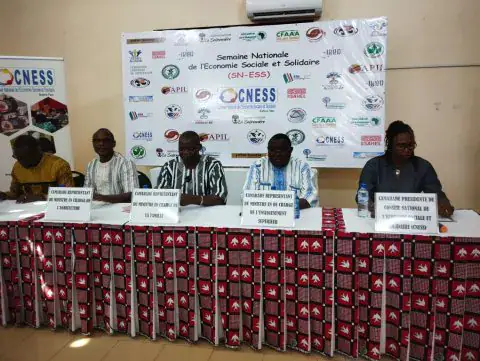
The second edition of the National Social and Solidarity Economy Week (ESS) kicked off on November 25, 2026, in Ouagadougou, under the theme "ESS and Research in Burkina Faso: Innovating and Incubating for Food Sovereignty." This event, organized by the National Social and Solidarity Economy Council (CNESS), brings together ESS stakeholders, researchers, producers, and incubation structures to discuss food sovereignty challenges.
According to Sylvie Emmenegger Ouédraogo, president of CNESS, the chosen theme aims to evolve collective initiatives into more effective models, leveraging scientific research. She emphasized that collective goodwill is no longer sufficient; organizations need to integrate technological, organizational, and entrepreneurial advancements, combining collective strength with scientific intelligence.
The CNESS plans to facilitate dialogue between researchers, producers, managers, agroecologists, and transformational actors during this week-long event. The goal is to bridge the gap between scientific knowledge and field realities, promoting practical applications in economic activities. Incubation structures will also share their experiences to support the transformation of community initiatives, particularly those led by young people and women, into sustainable and competitive enterprises.
Sylvie Emmenegger Ouédraogo highlighted that social and solidarity economy is built on principles of solidarity and prioritizing human needs over capital. She asserted that this economy serves as a powerful shock absorber and a significant driver of shared wealth creation. The event is hosted by the Pan-African Institute for Development – West Africa and the Sahel (IPD-AOS), which has been supporting initiatives and training in this field for several years.
IPD-AOS regional director, Dr. Sylvestre Ouédraogo, welcomed the event, noting that his institution has been working on establishing a national framework to promote social and solidarity economy for about a decade. He emphasized the importance of celebrating social and solidarity content through CNESS, which aligns with IPD-AOS's mission to contribute to population development.
Sagnon Somé, representing the Minister of Family, stressed the importance of bridging the gap between research and social economy actors to accelerate Burkina Faso's food sovereignty. He argued that, in the current national context, food sovereignty is not just a sectoral ambition but a foundation for dignity, social stability, and collective independence.
Beyond institutional and scientific exchanges, this second edition of the National Social and Solidarity Economy Week aims to showcase the know-how of social economy actors. The event seeks to bring research, collective entrepreneurship, and population needs closer together, as food sovereignty remains a significant challenge for Burkina Faso.
Key points
- The Burkinabé government is leveraging research and innovation to achieve food sovereignty.
- The National Social and Solidarity Economy Week brings together stakeholders to discuss food sovereignty challenges.
- The event aims to bridge the gap between scientific knowledge and field realities, promoting practical applications in economic activities.